REVIEW · BRUSSELS
Brussels 3-Hour Guided Art Nouveau Tour
Book on GetYourGuide →Operated by Bravo Discovery · Bookable on GetYourGuide
Can one style turn an ordinary street magical?
Brussels’ Art Nouveau isn’t just pretty facades, it’s a real way of building with iron, glass, wood, and stone in bold, personal compositions. I love how this 3-hour guided walk shows you the design logic behind the look, not just the names on the plaques. You’ll start at Grand-Place and follow the style into the Bailli district, where the city’s Art Nouveau density suddenly makes sense.
What I like most is the stop-by-stop focus. You’ll hit major works tied to Victor Horta, plus key houses by Octave Van Rysselberghe, Henry van de Velde, Paul Hankar, Albert Roosenboom, and others. Another win: even though you’re mainly viewing exteriors, guides often bring photo material for interior design cues, so you’re not stuck guessing what’s happening inside.
One consideration: you’ll do a good amount of walking and one tram hop, and the tour is built around seeing buildings from the street. If you’re hoping for lots of door-open interior time, you may feel a bit “outside-only,” unless you plan a separate visit to the Victor Horta Museum right after.
In This Review
- Key moments worth aiming for
- The Bailli district Art Nouveau walk: why it works
- Meeting at Grand-Place: find the white umbrella
- The quick tram ride to Bailli: a practical orientation reset
- Stop-by-stop: what to look for at each Art Nouveau address
- Old England House (Music Instrument Museum)
- Hotel Tassel (Victor Horta)
- Van Rysselberghe House (Octave Van Rysselberghe, 1912)
- Hotel Otlet (Octave Van Rysselberghe and Henry van de Velde, 1894–1898)
- Hotel Goblet d’Alviella (Octave Van Rysselberghe, 1882)
- Hotel Ciamberlani (Paul Hankar, 1897)
- René Janssens house (painter, 1898)
- Architect Armand Van Waesberghe
- The Beukman house (Albert Roosenboom, 1900)
- Paul Hankar private home
- Victor Horta Museum: make the ending count
- Price and logistics: is $35 good value?
- What you’ll learn to spot after the tour
- Who should book this Art Nouveau tour (and who might skip)
- Should you book?
- FAQ
- Where does the tour start?
- What time does the tour begin?
- How long is the Brussels Art Nouveau guided tour?
- How much does it cost?
- What languages is the guide available in?
- Is transportation included?
- Is museum admission included?
- Is the tour wheelchair accessible?
- Can I cancel for a refund?
Key moments worth aiming for
- Grand-Place start at 10:00, easy to find and great for getting your bearings fast
- Bailli district focus, where Art Nouveau feels concentrated enough to study in one afternoon
- Stop-by-stop authorship, linking houses to architects like Victor Horta, Paul Hankar, and Henry van de Velde
- Material clues you can spot, like how iron and glass frame light, curves, and structure
- Photo help for interiors, so you understand what you can’t see directly
The Bailli district Art Nouveau walk: why it works
Brussels Art Nouveau can feel overwhelming at first. You see a few ornate facades and think, okay, fancy flowers and scrollwork. Then you get close, and the style snaps into focus: lines that guide your eye, structural elements that double as decoration, and rooms planned around light and flow.
That’s why this tour’s route matters. You don’t just bounce between random buildings. You start in the center at Grand-Place, then head into the Bailli area, the part of town often described as the city’s densest Art Nouveau neighborhood. By the time you reach the later stops, you start spotting patterns on your own: how the frontage sets up a rhythm, how window shapes echo ironwork, and how stone frames what glass is doing.
Also, this is not a “lecture from a distance” kind of outing. It’s a guided walk paced for looking. Comfortable shoes are a must, because the best parts are the details—on balconies, around doorways, and in the way iron and stone meet.
You can also read our reviews of more guided tours in Brussels

Meeting at Grand-Place: find the white umbrella
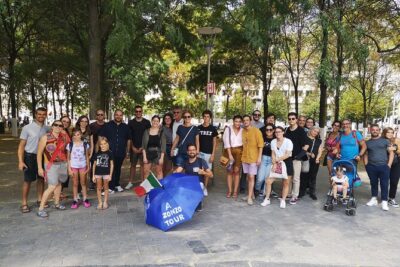
The tour begins at 10:00 at the Grand-Place. Your guide will be holding a white umbrella, so you’re not wandering around guessing which group is yours.
This matters more than you’d think. Grand-Place is a big visual bowl. Start time and a clear meeting point help you avoid losing time while searching. Once you’re on the right tram toward Bailli, the route becomes easy to follow.
The guide speaks Spanish, English, or French. In practice, it can also mean you hear the same explanation more than once in bilingual groups, which can stretch the pace a bit. The upside is you’re less likely to miss key points about why these houses look the way they do.
The quick tram ride to Bailli: a practical orientation reset
After meeting in the center, you’ll take a tram to the Bailli district. This is a smart shortcut. Brussels is compact, but Art Nouveau isn’t evenly spread. Using transit means you spend less time commuting and more time on the blocks where you can actually compare one architect’s style to another.
You also start shifting your mindset. In the Grand-Place area, you’re surrounded by “old city” icons. On the tram ride, you’re mentally switching gears to late-19th/early-20th century design—when iron, glass, and new building techniques changed what architects believed was possible.
Stop-by-stop: what to look for at each Art Nouveau address
Old England House (Music Instrument Museum)
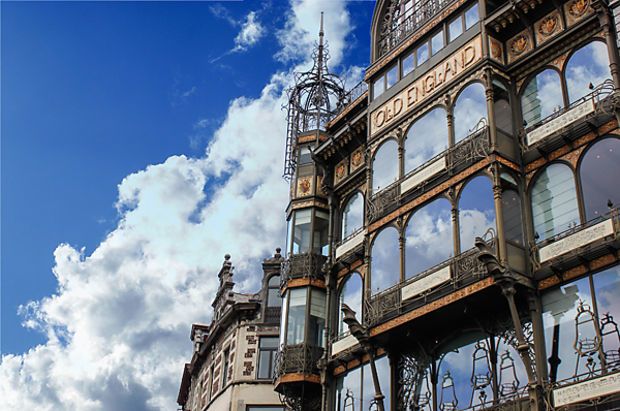
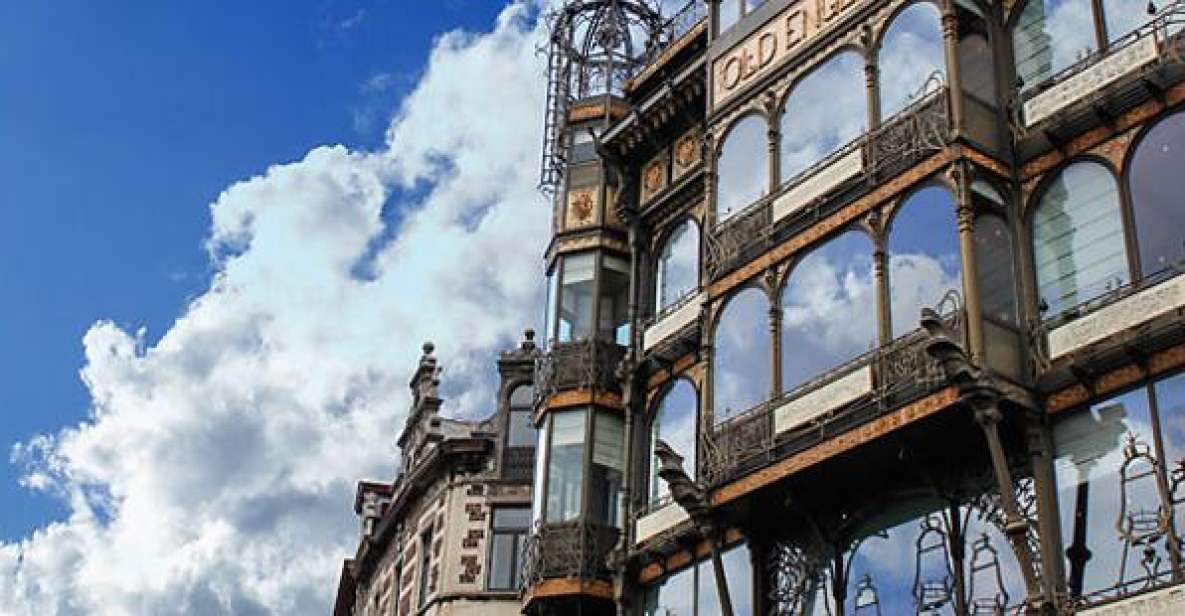
The tour’s first architectural hit is the Old England House, now connected with the Music Instrument Museum. From outside, treat this stop as a warm-up for “how Brussels does grand.” Look for the sense of structure and flow in the facade—how the building invites your eyes to move rather than just sit and stare.
This is also a useful transition point. Your guide can frame how Art Nouveau wasn’t a single look. It was a mindset: design as an integrated system, not a layer of decoration pasted onto older forms.
You can also read our reviews of more tours and experiences in Brussels

Hotel Tassel (Victor Horta)
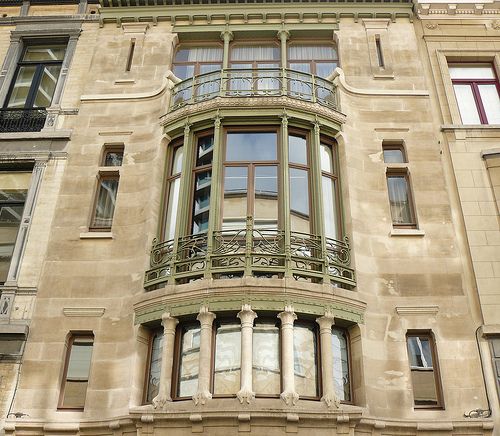
Next comes one of Victor Horta’s signature addresses: Hotel Tassel, built in 1893–1894. This stop is where the tour usually clicks for first-timers.
If you remember only one thing for Horta, make it this: Art Nouveau often feels “alive” because it borrows motion from nature but builds it with engineered logic. Watch for curved lines, window rhythm, and how vertical elements pull you upward.
Horta is also a reminder that this style was part of a bigger change: new materials, new engineering confidence, and a belief that modern life deserved modern design. You’ll hear that story in plain terms, not academic fog.
Van Rysselberghe House (Octave Van Rysselberghe, 1912)
Then you shift to a different architect voice with the Van Rysselberghe House (built 1912). This is where you can learn the difference between “Art Nouveau as a general look” and “Art Nouveau as individual authorship.”
At this kind of stop, I like to scan for repeated motifs: how the facade uses certain curves or how the window layout interacts with ornamental framing. Your guide’s narration helps you connect those choices to the architect, so later buildings don’t just feel like one long parade of pretty stonework.
Hotel Otlet (Octave Van Rysselberghe and Henry van de Velde, 1894–1898)
The tour then moves to Hotel Otlet (built 1894–1898), created by Octave Van Rysselberghe with Henry van de Velde. This is a strong stop for understanding Art Nouveau’s “design system” approach.
While you’ll mainly see the exterior, you can still spot how the building’s structure influences its look. The way openings are shaped and aligned often tells you how the architect expected light and space to behave. This is the kind of place where interior context—often shared via guide photos—can make the facade feel less decorative and more purposeful.
Hotel Goblet d’Alviella (Octave Van Rysselberghe, 1882)
A key early milestone follows: Hotel Goblet d’Alviella (built 1882). This address is useful for perspective. Art Nouveau didn’t appear out of nowhere. It evolved, and you can often trace the style’s growing confidence by comparing earlier and later houses on the walk.
From the street, you’re looking for early signals: the beginning of more organic curves, more personal ornament choices, and a different relationship between facade and frame. Your guide helps you read those signals instead of just admiring the surface.
Hotel Ciamberlani (Paul Hankar, 1897)
Now it’s Paul Hankar territory with Hotel Ciamberlani (built 1897). Hankar’s work often feels more sculptural and slightly more restless in its angles and compositions.
When you get to this stop, slow your pace by five seconds. That’s usually enough time to catch how ornament and architecture team up. The facade isn’t only pretty; it’s built to guide movement around the building and keep you looking at the same place from different angles.
René Janssens house (painter, 1898)
The tour continues to the house of painter René Janssens (built 1898), also associated with Paul Hankar. This is a good “human scale” moment. Art Nouveau wasn’t only for architects and wealthy clients with grand public ambitions. It also lived in homes and personal spaces shaped by art-making life.
From outside, you can still learn a lot by comparing this residence to the hotels. Look at proportions. Look at how private-home entrances and window groupings feel different from grander, more formal buildings.
Architect Armand Van Waesberghe
Next is the architect Armand Van Waesberghe stop. Even without seeing inside, this is where you can learn a useful habit: start reading the building like a person created it. Architects often design in ways that reflect their thinking about how people should move, see, and live.
Your guide can connect the dots so it doesn’t feel like a random list of names. You start understanding that Art Nouveau in Brussels is a web of overlapping careers and shared experimentation.
The Beukman house (Albert Roosenboom, 1900)
Then comes the Beukman house (built 1900) by Albert Roosenboom. This stop helps you compare material handling and facade balance across different architects.
I like to look for how the building uses verticals and how it breaks up the facade into zones. Art Nouveau often feels “designed” in sections, not one flat panel. Once you spot those zones, the style becomes easier to read on your own later.
Paul Hankar private home
The walk finishes with the private home of Paul Hankar. This kind of stop is important for shifting your view. By now, you’ve seen hotels and more public-facing grand houses. A private home reframes the whole style as lived-in architecture.
Even if the exterior is all you get here, the guide’s framing often makes you think about daily movement: where light would land, how the facade might relate to rooms within, and how ornament might serve function as well as beauty.
Victor Horta Museum: make the ending count
The tour ends in front of the Victor Horta Museum. This is a smart place to finish, because it gives you a natural next step: if the museum is part of your plan, you can go right away and connect the story you just heard to an actual preserved space.
A practical tip: pre-book museum tickets if you can. The tour can end and immediately create a “now I want to see it” moment, which is great—unless ticket time slots are gone.
Even if you’re not doing the museum that day, the stop still works. It anchors Horta’s influence. You end the walk with his architectural world in view, and that makes the last few houses land better because you can feel the through-line.
Price and logistics: is $35 good value?
At $35 per person for a 3-hour guided tour, the value comes from how much you get organized for you.
You’re covering a concentrated set of notable Art Nouveau buildings tied to major names, plus a guided interpretation of how the style uses materials like iron, glass, wood, and stone. That’s the part that costs time if you try to DIY. Without a guide, you can see beautiful facades and miss the design logic that makes Art Nouveau feel coherent.
There’s also a hidden value: you get help noticing. Guides often have printed photo material for interiors, because many of these buildings are not set up as walk-in viewing stops during the tour. That photo support means you’re not stuck only judging a facade.
Logistics to keep in mind: the tour includes a tram leg. The info you have says transportation by train isn’t included, so don’t assume transit is free. Bring the means to cover any needed public transport, and plan on the walking.
What you’ll learn to spot after the tour
By the end, you should be able to notice patterns quickly. Here’s what I think is most useful to take home:
- Art Nouveau often uses line and structure to create motion, not just surface decoration.
- Material choices are part of the design language, so iron and glass aren’t “extras.”
- Different architects in Brussels have distinct personal signatures, even when they’re working in the same style period.
- Interiors are part of the story, even when you can’t enter most houses, which is why photo references matter.
This is where the tour feels worth it. It changes your eyes, not just your memory.
Who should book this Art Nouveau tour (and who might skip)
Book it if you want a structured introduction to Victor Horta and Brussels Art Nouveau without spending your day hunting addresses. This is especially good for first-time visitors who want to get beyond a few Instagram facades.
You might skip or add a plan if you’re chasing lots of interior access during the 3 hours. The tour is built around street viewing, and the ending at the Victor Horta Museum is your best chance to connect exterior details to an interior setting.
It’s also a strong pick if you like design explanations in different languages, since guides work in Spanish, English, and French, and translation support can help you keep up.
Should you book?
Yes, if your goal is to understand Brussels Art Nouveau in a way you can actually see. For $35, the combination of a focused route, multiple major architect names, and guidance on what to look for makes this a practical first stop.
If you only want interiors and you hate walking, then treat this as a “see the faces, then go inside somewhere else” outing. Pair it with a museum visit—ideally right after—so your day ends with the real interior context that makes the style click.
FAQ
Where does the tour start?
The meeting point is the Grand-Place in Brussels. You’ll find the guide holding a white umbrella.
What time does the tour begin?
The tour starts at 10:00.
How long is the Brussels Art Nouveau guided tour?
It lasts 3 hours.
How much does it cost?
The price is $35 per person.
What languages is the guide available in?
The live guide works in Spanish, English, and French.
Is transportation included?
The tour includes the guided experience, but transportation by train is not included. The route includes a tram ride, so you may need a transit ticket depending on what’s covered.
Is museum admission included?
No. Museum admission is not included.
Is the tour wheelchair accessible?
Yes. The tour is wheelchair accessible.
Can I cancel for a refund?
Yes. You can cancel up to 24 hours in advance for a full refund.