REVIEW · BRUSSELS
Private Tour – Bruges and Ghent, our fairytale cities
Book on Viator →Operated by Brussels City Tours - Keolis Travel · Bookable on Viator
Ghent and Bruges in one day is a sweet trade. This private tour connects medieval icons in Ghent with the postcard-perfect lanes and canals of Bruges, guided in English, French, or Spanish for real clarity as you walk.
I love that most major stops come with free entry, so your money goes to seeing more instead of paying a long list of tickets. I also love the guide approach, since someone local can point out what matters fast—especially on days when Bruges can feel crowded.
One thing to consider: you’re on your feet for a full long day (moderate fitness helps), and Bruges can be busy, so you’ll want good walking shoes and patience.
In This Review
- Key highlights to zero in on
- Why Ghent first, Bruges second makes sense for a 9:00 a.m. start
- Price and value: what $57 buys you (and what it doesn’t)
- The private-group comfort setup: multilingual guide + radios
- Ghent stops that map the city fast: from Belfry views to a real castle
- Het Belfort van Gent (Ghent Belfry)
- Graslei and Korenlei (the river quays)
- St. Bavo’s Cathedral (and why it’s more than a big church)
- Gravensteen (the medieval castle that kept changing jobs)
- Saint Nicholas Church (an older anchor point)
- Bruges sights you’ll actually remember: Holy Blood to city squares and Beguinage calm
- Basilica of the Holy Blood
- Onze-Lieve-Vrouwekerk (Church of Our Lady) and its towering brickwork
- Stadhuis (Bruges City Hall) in Burg Square
- Minnewater Lake (Lake of Love) and Lovers’ Bridge
- Princely Beguinage Ten Wijngaarde (still a place of contemplation)
- Historic Centre of Brugge (optional canal tour)
- When churches and art come with rules: Sunday and access tips
- Walking, timing, and the real-life crowd factor in Bruges
- Food isn’t included: how to handle lunch without losing the day
- Who should book this Ghent and Bruges private tour
- Should you book? My practical recommendation
- FAQ
- What languages are available for the guide?
- Is food included in the tour price?
- Do I get time to explore on my own?
- Can I book the Bruges canal tour in advance?
- Is there free admission for the main stops?
- Do I need to bring my passport?
- Will the tour be canceled if it rains?
- Can I cancel and get a full refund?
- Is the tour suitable for people with disabilities?
Key highlights to zero in on
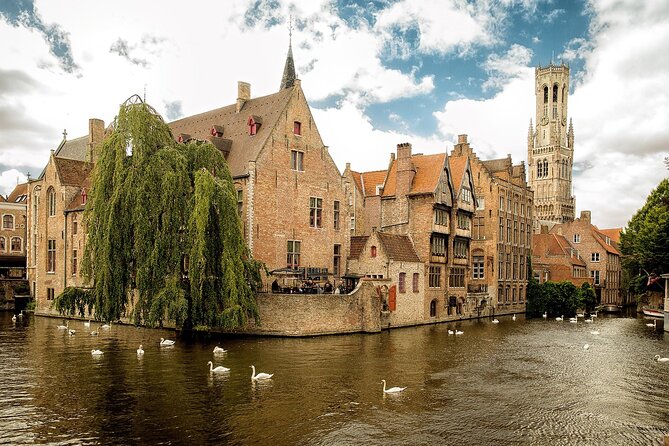
- A true two-city pairing: Ghent’s medieval core and student-energy feel, then Bruges’ quieter, canal-side vibe
- Free entry at nearly every main stop: Belfries, cathedrals, churches, and the castle with admission listed as free
- A local guide who changes the experience: you’re not just looking—you’re understanding
- Multilingual options: choose English, French, or Spanish when booking
- Optional Bruges canal tour: book it with your guide on the day (extra cost)
- Comfort during the long stretch: air-conditioned coach plus radios/earphones when needed
Why Ghent first, Bruges second makes sense for a 9:00 a.m. start
This is built like a full day with a clean rhythm. You start at 9:00 a.m. from a meeting point near public transport, then head out by air-conditioned coach. The biggest practical win is that you get to cover both cities without spending your holiday time figuring out trains, transfers, and timing.
Ghent is a smart first stop because it’s easier to get your bearings there. The city has big medieval landmarks grouped closely enough that you can walk between them without feeling like the day is stretching. Then, later, you shift to Bruges, which tends to draw more day-trippers. Going after you’ve already set your “medieval city pattern” in your head helps you enjoy Bruges more instead of getting lost in the crowd.
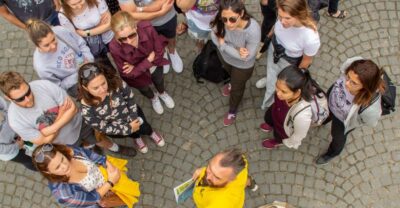
Also, this tour is private in the sense that only your group is participating. That matters. You can ask questions without fighting the noise level of a large group, and the guide can pace you according to how your group walks and pauses.
You can also read our reviews of more private tours in Brussels


Price and value: what $57 buys you (and what it doesn’t)
At $57 for a day that runs about 10 hours 30 minutes, the value is all about inclusions and what’s not included. You’re paying for:
- A professional multilingual guide
- Air-conditioned transportation
- Mobile ticket support (and radios/earphones when needed)
- A route that hits major sights across both cities
Then, the best part for your budget: admission is listed as free for every listed stop (belfry, cathedrals, churches, castle, and Bruges landmarks). The only clearly “extra” sight is the optional Bruges canal tour, and food/drinks aren’t included.
So, you get a long, structured day with lots of famous buildings and historic squares—without the usual trap of adding up ticket fees stop by stop. If you’re the kind of traveler who hates nickel-and-diming during the day, this is the kind of itinerary that feels fair.
What’s not included is also important: food and drinks. You’ll want to plan your lunch strategy, and don’t assume the tour will carry you through a sit-down meal. The good news is that your guide can help you choose where to eat once you’re on the ground.
The private-group comfort setup: multilingual guide + radios
A day like this can feel overwhelming if you’re just reading signs as you go. Here, you’re traveling with a professional local guide who works in English, French, or Spanish. That language choice isn’t a small detail. It changes how much you get from the buildings, since the guide can explain what you’re seeing while you’re standing right there.
Practical bonus: the tour includes radios + earphones when necessary. That means you don’t have to strain to hear over street noise, groups, or church bells. It keeps the day moving at a human pace—more “conversation” than “walk faster.”
Also, it’s a mobile-ticket experience. That typically reduces the friction of entry days, even though you still should keep an eye on any specific church rules for access.
Ghent stops that map the city fast: from Belfry views to a real castle
Ghent has two moods that work well together: medieval grandeur and a young, active street life. You’ll feel that mix as you go.
Het Belfort van Gent (Ghent Belfry)
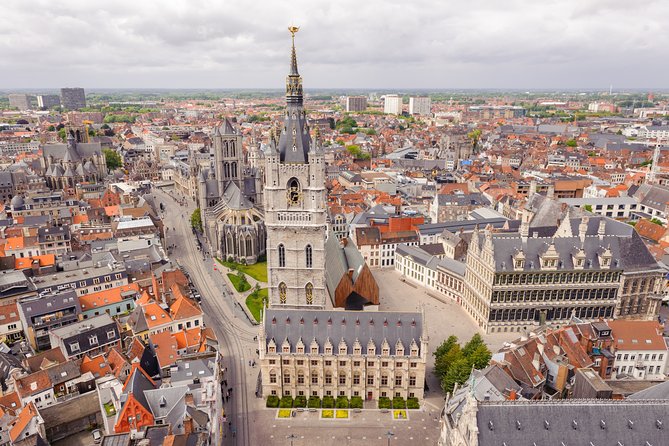
You start with the 91-metre-tall belfry overlooking the old center. This is one of three medieval towers in Ghent that helped define the skyline: alongside the towers of Saint Bavo Cathedral and Saint Nicholas’ Church.
Even if you don’t climb anything, this stop is useful because it gives you a landmark. From there, your photos and your mental map lock in quickly. It’s also a way to understand Ghent as a medieval city that organized civic power around towering structures, not just churches.
Admission is listed as free.



Graslei and Korenlei (the river quays)
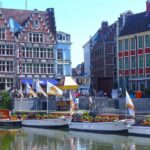
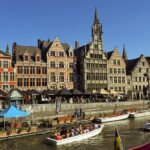
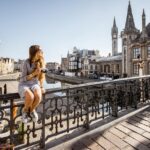
Next you hit the famous quays: Graslei and Korenlei on the right bank of the Leie river. This is the kind of place where “pretty” isn’t the point—it’s how the city used water for trade and identity. You’ll see why these spots became the heart of the old town for centuries.
If you’re short on time, spend your best minutes here just watching the scene and taking in the architecture angles. The river gives Ghent depth, and this is where the city really starts to look like the fairytale frame on your camera.
Admission listed as free.
St. Bavo’s Cathedral (and why it’s more than a big church)
St. Bavo’s Cathedral is 89 metres and a major Gothic landmark, and yes, it’s the home of the Ghent Altarpiece. Even if you don’t plan a deep art study, knowing that this cathedral houses the altarpiece helps you understand why people cluster here so intensely.
This stop also sets you up for a key timing tip: access can vary by day. The tour data notes that access to the Mystic Lamb at St Bavo’s Cathedral is not possible on Sundays. If your trip lands on a Sunday, adjust expectations and use your time for the cathedral itself and the exterior context.
Admission listed as free.
Gravensteen (the medieval castle that kept changing jobs)
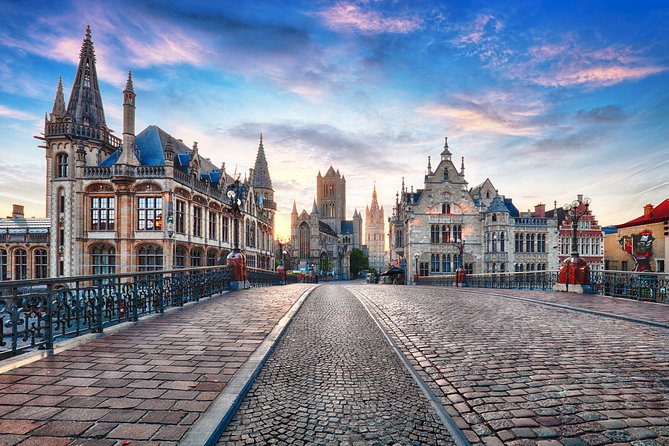
Then you switch gears—Gravensteen, the castle with roots in 1180. It was a residence of the Counts of Flanders until 1353, then repurposed over time as a court, prison, mint, and even later as a cotton factory.
This is a great stop if you like places that explain how power and industry evolved. You’re not just seeing a “pretty old castle.” You’re seeing how one structure could serve multiple roles depending on who ruled and what the city needed.
Admission listed as free.
Saint Nicholas Church (an older anchor point)
Saint Nicholas’ Church is one of Ghent’s oldest and most prominent landmarks. Construction began in the early 13th century as a replacement for an earlier Romanesque church.
This is a good “anchor” stop. By now, you’ll recognize the pattern: medieval Ghent marks its identity with big church landmarks plus civic structures like the belfry. This one rounds out the skyline story.
The stop is listed for 10 minutes with free entry.
Admission listed as free.
Bruges sights you’ll actually remember: Holy Blood to city squares and Beguinage calm
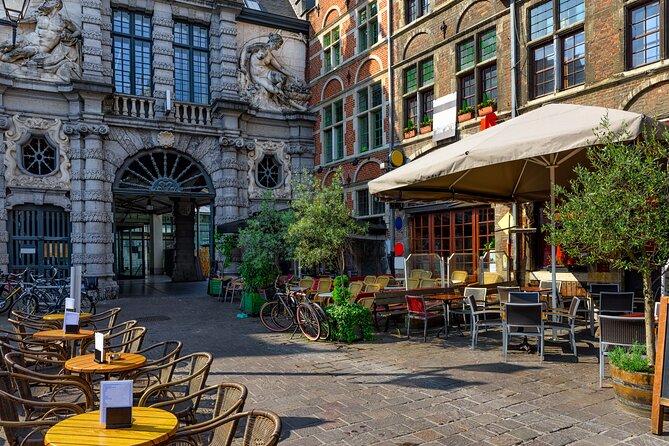
Once you transition into Bruges, the vibe changes. You’ll still see historic power buildings and religious landmarks, but Bruges feels more like a walkable series of scenes: canals, squares, and iconic brick-and-stone details.
Basilica of the Holy Blood
The Basilica of the Holy Blood is one of Bruges’ signature stops. The key detail is the relic tradition: the church houses a venerated relic of the Holy Blood, allegedly collected by Joseph of Arimathea and brought from the Holy Land by Thierry of Alsace.
Even if you’re not tracking every religious claim, it helps you read Bruges as a place where symbolism attracted pilgrims—and money. People built and maintained places like this because meaning mattered to the city’s economy and reputation.
Stop time is listed as 10 minutes, admission free.
Onze-Lieve-Vrouwekerk (Church of Our Lady) and its towering brickwork
This church dates mainly from the 13th, 14th, and 15th centuries, and its tower—115.6 metres—is the tallest structure in Bruges and the second tallest brickwork tower in the world (as stated in your tour info).
This stop is about proportions. Look up. Feel the scale. Bruges is famous for looking small, but buildings like this prove the city wasn’t just charming—it was ambitious.
Stop time is listed as 15 minutes, admission free.
Stadhuis (Bruges City Hall) in Burg Square
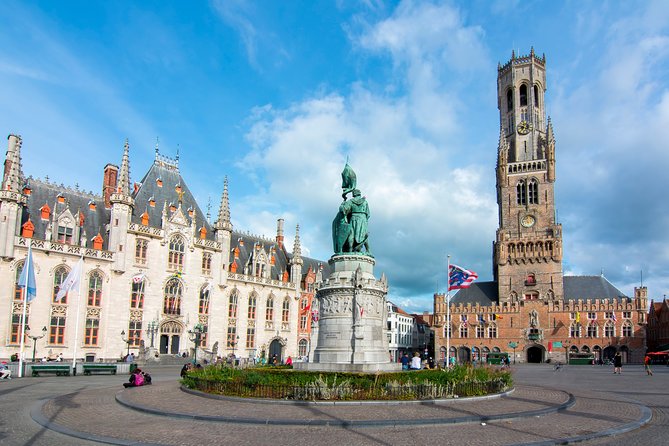
Next is Stadhuis, the city hall located at Burg Square in the former fortified-castle area. Burg Square is framed as the political center, so you’ll get a sense of how governance sat in the middle of everyday life.
It’s a short stop—10 minutes—but it’s worth it because it gives you the civic counterpart to the religious sites you’ve already seen.
Admission free.
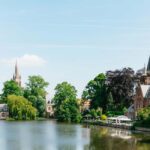
Minnewater Lake (Lake of Love) and Lovers’ Bridge
Then you get a visual reset at Minnewater Lake, known as the Lake of Love, with the Lovers’ Bridge. This is a calmer, romantic pause inside the city.
I like using this moment as a breathing point. After churches and civic buildings, the water scene lets your eyes rest and helps you recharge before the final stretch.
Stop time is listed as 15 minutes, admission free.
Princely Beguinage Ten Wijngaarde (still a place of contemplation)
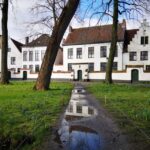
You finish with the Princely Beguinage Ten Wijngaarde, described as the only preserved beguinage in Bruges. The tour info notes there are no more beguines living there, but since 1927 it functions as a convent for Benedictines.
This is where Bruges slows down. Beguinages are distinctive because they reflect community living built around faith and daily routine, not grand palace power. It’s one of the spots that makes the city feel lived-in rather than only museum-like.
Stop time is listed as 10 minutes, admission free.
Historic Centre of Brugge (optional canal tour)
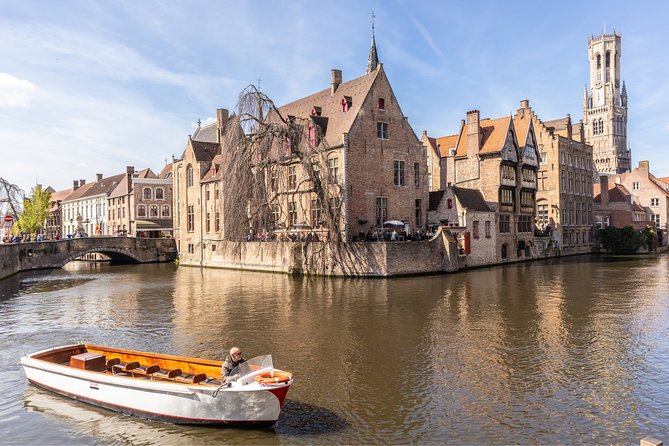
There’s also time for the optional canal tour. The key practical detail: it’s not included, and it can only be booked with your guide on the day.
This matters because a canal tour is one of those things that can make Bruges click fast—especially if you want a different angle than the streets provide. But it’s also weather-dependent in your real-life experience, so treat it like a bonus plan, not a must.
The historic center stop includes 30 minutes for the optional canal tour time window.
When churches and art come with rules: Sunday and access tips
One specific heads-up: access to the Mystic Lamb at St Bavo’s Cathedral is not possible on Sundays. If your day lands on Sunday, I’d plan to focus on the cathedral atmosphere and the overall cathedral visit rather than expecting that particular experience.
On a broader note, church visits tend to run with their own rhythms—quiet, crowds, and sometimes short pauses for groups. Your guide is the best person to ask how long you should plan to linger at each stop so you don’t miss the next point.
Walking, timing, and the real-life crowd factor in Bruges
This tour is designed around walking, and the tour data says moderate physical fitness is recommended. That’s not a warning sign. It’s a planning tool.
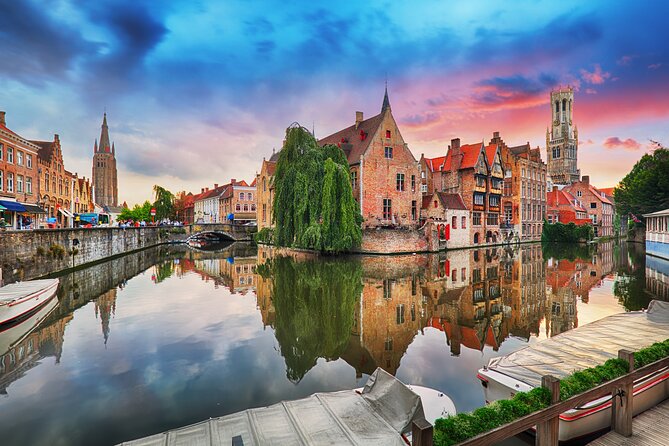
Bring comfortable walking shoes, since you’ll move through multiple neighborhoods in both cities. Also, plan for the fact that Bruges can be busy. If your group wants photos without sprinting, keep your pace steady and leave room for pauses at the canal-quay and square areas—those are the shots you’ll want.
One practical way to handle crowds: use your free moments to step slightly away from the main lanes. Your guide can often suggest where to stand and how to move so you spend time seeing, not circling.
Food isn’t included: how to handle lunch without losing the day
Lunch and drinks are not included, so you’ll want to treat meal time as part of your day plan. The tour includes free time, and the guide can help you find where to eat and what to see in the remaining minutes.
I’d do two things:
- Decide your lunch style in advance: quick bite vs sit-down
- Ask your guide for a nearby option that matches your pace
That way you don’t burn time hunting while your group is tired. On a day that runs over 10 hours, time management is comfort management.
Who should book this Ghent and Bruges private tour
This tour fits best if you:
- Want a guided day connecting two medieval cities instead of juggling transit on your own
- Like the combo of civic landmarks and religious sites (belfry, cathedrals, city hall, castle)
- Prefer your history explained in English, French, or Spanish without needing to read everything yourself
- Want the budget-friendly bonus of free entry at many major stops
It’s less ideal if:
- Your group struggles with walking or long days, since the tour calls for moderate physical fitness
- You want a fully self-paced itinerary with lots of extra “wander until we feel like it” time. This is structured, with specific stop timing and a planned route.
If your goal is to see the highlights and understand them, this is a strong match.
Should you book? My practical recommendation
If you want a smart, organized day that covers Ghent and Bruges with minimal friction, I think this is worth considering. The standout value is the mix of private-group comfort, a multilingual guide, and lots of free admissions—so you can focus your energy on the sights instead of the logistics.
Book it if you’re happy with a long walking day and you want a guided route that makes both cities feel coherent. Skip it (or plan carefully) if you need very slow pacing or if you’re traveling with mobility limitations.
Want the best result? Wear good shoes, bring cash for small purchases and optional extras, and ask your guide where to pause for photos so you don’t spend your day battling crowds.
FAQ
What languages are available for the guide?
The tour can be done in English, French, or Spanish.
Is food included in the tour price?
No. Food and drinks are not included.
Do I get time to explore on my own?
You will have free time on every excursion (except tours within Brussels). Your guide can share the timing details on the day.
Can I book the Bruges canal tour in advance?
No. The canal tour can only be booked with your guide on the day of your trip.
Is there free admission for the main stops?
The tour info lists admission as free for the listed sights, while the canal tour in Bruges is not included.
Do I need to bring my passport?
No border controls are mentioned once you enter the Schengen Area, but it’s advised to carry an ID with you at all times.
Will the tour be canceled if it rains?
No. The tour is only canceled in case of extreme weather like heavy storms or floods.
Can I cancel and get a full refund?
Yes, you can cancel up to 24 hours in advance for a full refund.
Is the tour suitable for people with disabilities?
Unfortunately, it is not recommended for individuals with disabilities or those who have difficulty walking.