REVIEW · YPRES
From IEPER Private 4-hour Tour of the Ypres Battlefield
Book on Viator →Operated by A Foreign Field WW1 Tours · Bookable on Viator
Ypres hits fast, and this tour helps it make sense. You get a private, guided loop of the sites that shaped the war around Ieper, with stops timed so you’re not rushed.
Two things I especially like: the way the guide uses maps and photos to explain what you’re seeing, and how personal it can get—Søren, Sabine, and others have even checked records so your visit connects to family stories. A possible drawback: this is a heavy, emotional subject, so if you want a lighter day, you may need to mentally pace yourself.
In This Review
- This is WWI, not a drive-by list
- Key things that make this tour worth your time
- Ypres in four hours: what you really get out of the loop
- Private guide energy: maps, photos, and why it feels personal
- Pickup and timing: morning or afternoon works, and comfort matters
- Stop 1: Hill 60 and the June 7, 1917 mines
- Stop 2: Sanctuary Wood Museum trenches and the WWI ground truth
- Stop 3: Tyne Cot Cemetery and why “only 3,000 have names” stuns you
- Stop 4: Saint Julien Memorial and the April 22, 1915 gas attack
- Stop 5: Essex Farm Cemetery, McCrae, and the poppy origin
- Why this sequence works (and where it might not)
- Value check: is $399.25 per group worth it?
- Who should book this WWI battlefield tour
- Should you book the Ieper Private 4-hour Ypres Battlefield Tour?
- FAQ
- How much does the tour cost?
- How long is the tour?
- Is the tour private?
- Do you offer morning and afternoon times?
- Where can the guide pick you up?
- What language is the tour offered in?
- Are entrance fees included for the sites?
- How do I receive tickets?
- What is the cancellation policy?
This is WWI, not a drive-by list
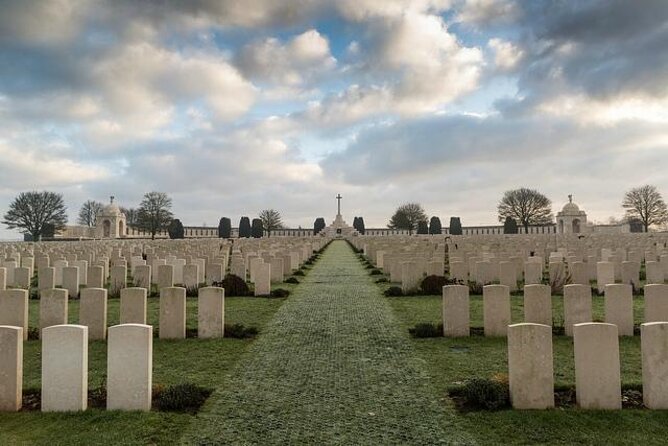
The format is simple and effective. You start with Hill 60, walk through the trench story at Sanctuary Wood, and then move to the big memorial spaces like Tyne Cot and Saint Julien—so your understanding builds step by step instead of jumping around.
The only thing to watch is time: 4 hours sounds like plenty until you’re standing in places that can swallow an afternoon. If you’re hoping to linger hard at every stop, plan to take breaks for questions and still accept that some areas stay brief.
Key things that make this tour worth your time

- Private-only experience with room to ask questions and set the pace
- Family-history friendly guides who may research a relative’s link to the area
- Trench-to-memorial flow that explains events without turning into a classroom
- Sanctuary Wood’s real trench remains and the WWI tunnel experience
- Tyne Cot’s scale: huge graves, few names, and major Commonwealth connections
- Canadian focus at Saint Julien on the April 1915 chlorine gas attack
You can also read our reviews of more private tours in Ypres


Ypres in four hours: what you really get out of the loop
This tour is designed around how people actually learn WWI: you start with a concrete event, then you move into the ground-level reality, and finally you land at the places built to hold memory. Instead of scattering you across the region, it keeps the logic tight—so you leave with a clearer sense of where lines shifted and why specific sites matter.
You also avoid the worst kind of first-trip mistake: trying to drive around alone without a mental map of the battle geography. A guide’s job here is not just storytelling. It’s orientation—so when you’re looking at a cemetery or a memorial panel, you know what it’s answering.
And because it’s private, you’re not stuck matching your timing to strangers who may not care about the gas war, the mines, or a specific relative’s footsteps. In the reviews, guides like Søren repeatedly adjusted the day when families needed it.
Private guide energy: maps, photos, and why it feels personal
The strongest part of this experience is the guide-to-group connection. In practice, that means you can ask questions without feeling like you’re holding everyone up. It also means the day can shift toward what matters to you.
Søren is repeatedly praised for mixing clear explanation with respect for the subject, plus a bit of humor that doesn’t turn solemn places into a comedy stop. Sabine and Saline show up in reviews for similar reasons: they’re able to anchor the story with details and keep it understandable, even for people who start with zero WWI background.
One of the most memorable details from reviews is that guides have gone searching for family history. One guide asked for a service record so they could steer you toward the most relevant battlefields. That’s the big value of private touring: you can leave the generic route and follow a thread.
If you have walking restrictions, you’ll also appreciate flexibility. Reviews include examples of guides adjusting to surgery-related limits and still keeping the day meaningful. Another practical perk: guides have been happy to handle bags and drop you near the right lunch spot when the tour finishes.
Pickup and timing: morning or afternoon works, and comfort matters
You can choose a morning or afternoon time slot, and the tour runs about 4 hours. Pickup is offered from Ieper Train Station if you’re arriving by rail, and from your hotel or B&B in Ieper if it’s listed. If it’s not listed, you can message the operator with your accommodation name and they’ll meet you there.
Transport is handled in a comfortable vehicle (reviews mention a hybrid SUV), which matters in this part of Belgium where the distances add up when you’re driving yourself. The private format also helps here: the schedule can respond to your needs more easily than a set group bus time.
One small “local life” detail from the reviews: Søren suggested a supermarket stop for freshly made sandwiches for a train ride back to Paris. That’s the kind of practical advice that makes the tour feel like you hired a real partner in the trip, not just a driver with a script.
Stop 1: Hill 60 and the June 7, 1917 mines
Hill 60 is where the tour starts by hitting you with scale and engineering. Here you hear the story of the massive mines blown on 7 June 1917. It’s not just a dramatic moment from a textbook—it’s a window into how the war worked at ground level: digging, detonations, and the desperate logic of trying to break entrenched lines.
This is the first stop for a reason. Mines and tunnels explain why the landscape around Ypres became a maze of wartime activity. If you come in thinking WWI was only artillery barrages and marching, Hill 60 gives you a clearer picture of the methods used when movement was nearly impossible.
Time at this stop is about 40 minutes, with admission ticket noted as free. That duration is useful: long enough to absorb the story, short enough to keep the day moving toward the trenches where you can connect history to physical space.



Stop 2: Sanctuary Wood Museum trenches and the WWI ground truth
Sanctuary Wood Museum is where the tour becomes physical. You’ll see poignant original WWI trenches along with a small museum that helps you connect the broader battle story to what soldiers actually lived with.
One review highlight focuses on walking through a tunnel among the trenches. That’s the kind of detail that changes how you understand the fighting. From inside those spaces, the war stops being an abstract timeline and becomes a matter of tight movement, constant fear, and cramped survival.
The stop runs about 45 minutes, and museum admission is included. This is also a good place for questions. A guided explanation lets you look at the trench remains and ask the obvious things—what this section was for, how the layout shaped movement, and why the area mattered beyond its immediate moment.
Potential drawback: this stop can be intense, especially if you’re sensitive to the reality of what happened. But the guides in the reviews are clear about keeping the tone respectful and never turning it into a shock-tour.
Stop 3: Tyne Cot Cemetery and why “only 3,000 have names” stuns you
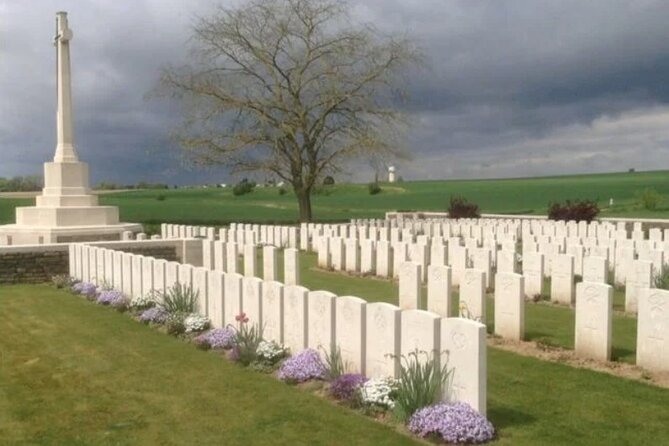
Tyne Cot is the tour’s gravity well. You visit the Commonwealth War Graves Commission cemetery, described as the world’s largest, with about 12,000 soldiers buried. Only 3,000 have names, and that fact lands hard when you’re standing there.
This cemetery helps you understand the cost of the war in a way that no lecture can fully replicate. The design is meant to preserve memory, but the numbers also show how incomplete records can be—families left with loss that wasn’t neatly documented.
Admission is listed as free, and you get about 45 minutes here. That time is enough to walk, pause, and absorb the details without feeling like you’re being marched through.
There’s also an important Commonwealth angle built into the stop: it includes two Australian and one Canadian Victoria Cross recipients buried there. If you care about Commonwealth contributions, this is where your interest is naturally rewarded with specific connections rather than vague references.
If you want a tip for getting more out of Tyne Cot: slow down for the named sections. The tour format gives you time to do that, and that’s usually where the emotional impact becomes clearest.
Stop 4: Saint Julien Memorial and the April 22, 1915 gas attack
Next you move to Saint Julien Memorial, which centers on one of WWI’s most frightening turns: the first major German gas attack of the war. The date here is 22 April 1915, first against French soldiers, and then the story connects to Canadian resistance—how the Canadians held the line facing a chlorine gas cloud.
This is a short stop—about 15 minutes—but it’s strategically placed after Tyne Cot for a reason. Tyne Cot gives you the scale of loss. Saint Julien explains part of how that loss was produced: weaponized fear meant to break humans, not just trenches.
If you’re Canadian (or connected to Canadian history), you may feel this stop more intensely because the narration keeps those links up front. Several reviews mention guides highlighting Canada’s role throughout the day, and Saint Julien is the anchor spot for that focus.
Stop 5: Essex Farm Cemetery, McCrae, and the poppy origin
You end at Essex Farm Cemetery, about 30 minutes, at the hospital site where Lt Col John McCrae composed In Flanders Fields. The stop also connects to how the poppy became the iconic WWI symbol.
This is the most “cultural” end of the tour, compared with the earlier military sites. But it’s not a detour. It gives you a bridge between battlefield reality and how societies tried to make sense of grief afterward.
What makes it stick is the way it answers an everyday question: why do people still associate the poppy with WWI? The story is attached to a real place and a real person’s moment of writing, not just a generic museum explanation.
Admission is listed as free. So you can spend your limited time focused on the meaning of the location, not on extra ticket steps.
Why this sequence works (and where it might not)
This day is built like a narrative ladder.
- Hill 60 starts with action and method—how WWI tried to change the stalemate.
- Sanctuary Wood shows the trench reality—what those methods created on the ground.
- Tyne Cot gives you the memorial math—scale, names, and Commonwealth links.
- Saint Julien adds the gas shock and the Canadian stand.
- Essex Farm closes with the writing and symbolism that followed.
That order is helpful for first-timers. It also helps repeat visitors, because you don’t just revisit sites—you get the why behind them again, with a guide tying it together.
Where it might not fit: if you’re the type who wants to stand for an hour at each monument and read every panel, four hours can feel tight. The tour’s strength is pacing and clarity, not long wandering time. The good news is that private touring usually means your guide can adjust within reason, especially if you explain what you want at the start.
Value check: is $399.25 per group worth it?
The price is $399.25 per group (up to 4) for about 4 hours. In practical terms, this is less about paying for “a bus” and more about paying for context.
If you’re traveling solo or as a couple, private tours can feel pricier than joining a group. But in this region, self-guided costs add up fast: car rental, fuel, parking time, and the biggest hidden cost—your uncertainty about what you’re looking at. When you hire a guide, you’re buying interpretation. And you’re buying time saved.
For a group of up to four, the value gets stronger quickly. You share one price, you get a tailored route, and you can split focus—one person may care about Canadian involvement, another may want trench layout detail, another may want to find where their relative fought.
This is also one of the few WWI tours where reviews consistently mention extra work—like researching family history and then bending the route around that. That kind of effort is hard to “price” but it’s real, and it’s why many people rate it a 5.
Who should book this WWI battlefield tour
This tour is a great match if you:
- Want a private experience with time for questions
- Care about Commonwealth connections (especially Canadian links)
- Have family history to follow and want it handled with care
- Prefer a guide who mixes clarity with respect, sometimes with light humor
It also works well across ages. Reviews include an example of families bringing children from 10 down to 6, with the guide staying patient and keeping it fun without losing the important parts. If you have older parents, the private format can also make the day more manageable.
Should you book the Ieper Private 4-hour Ypres Battlefield Tour?
I’d book it if you want the Ypres WWI story explained in a way that’s easy to follow and hard to forget. The biggest reason is the combination of private pacing plus guides who can personalize the day, even to the point of researching family links. You’ll also leave with a coherent sense of events, not just photos of cemeteries.
I’d think twice only if you’re looking for a casual, light outing or if you need long hours at fewer sites. This is a focused circuit, not a slow, read-everything day.
If you’re deciding soon: this kind of private tour tends to be booked about 61 days in advance, so planning ahead helps you get the time slot you want.
FAQ
How much does the tour cost?
It costs $399.25 per group (up to 4 people) for the private 4-hour experience.
How long is the tour?
The duration is about 4 hours.
Is the tour private?
Yes. It’s a private tour/activity, so only your group participates.
Do you offer morning and afternoon times?
Yes, you can choose between a morning or afternoon tour time.
Where can the guide pick you up?
Pickup is available at Ieper Train Station (if you arrive by train) or from Ieper hotels and B&Bs. If your accommodation isn’t listed, message the provider with the name and they will meet you there.
What language is the tour offered in?
The tour is offered in English.
Are entrance fees included for the sites?
Admissions are listed as free for Hill 60, Tyne Cot Cemetery, Saint Julien Memorial, and Essex Farm Cemetery. Sanctuary Wood Museum admission is included.
How do I receive tickets?
You get a mobile ticket.
What is the cancellation policy?
You can cancel for a full refund up to 24 hours in advance. If you cancel less than 24 hours before the start time, the amount paid is not refunded.