REVIEW · GHENT
e-Scavenger hunt Kortrijk: Explore the city at your own pace
Book on Viator →Operated by Qula · Bookable on Viator
A game turns Kortrijk into a scavenger race. This self-guided e-Scavenger hunt mixes classic sightseeing with a phone-based challenge, so you control the order and the pace. You’ll hit places tied to the Lys Valley, Gothic church façades, and Golden Spurs memorials, all while answering quiz-style questions on the spot.
What I like most is that it’s built for learning without babysitting: you can stop when something catches your eye, then move on when you’re ready. I also like how the route blends famous sights with places that feel more local, so the city doesn’t turn into one long photo sprint. The questions add a light competitive spark, and the setup is simple enough that even a family group can enjoy it.
One thing to consider: you’re relying on your own phone and positioning. If the phone GPS is flaky or street works hide a clue spot, you may need to use your map app and get a little patient.
In This Review
- Key highlights you’ll actually feel
- A phone game that still feels like real walking
- Start at Stationsplein and set your rhythm
- Beguinage UNESCO zone: 13th-century homes and living courtyards
- Where Kortrijk 1302 fits in
- Towers, ports of control, and the Lys Valley story
- Texture museum: flax to linen, with a Lys Valley twist
- Church of Our Lady and St. Martin’s Church: worship sites with deep roots
- Passionists Church: popular devotion, 19th-century style
- The Grote Markt power play: belfry, cloth hall echoes, and counts
- Groeninge portals and Golden Spurs memorials
- Baggaertshof and the city’s social history in miniature
- Gardens, the rose garden, and a calmer pace
- Shopping centers as part of the route (yes, really)
- Hospital courtyard: hospitality, not just illness
- Fortifications and war echoes: artillery tower
- Kortrijk Theatre and everyday culture
- Practical tips: GPS, street works, and scoring sanity
- Who should book this e-Scavenger hunt in Kortrijk?
- Should you book this in Kortrijk?
- FAQ
- How long is the e-Scavenger hunt in Kortrijk?
- How much does it cost and how many people can join?
- What do I need on my end?
- Is this self-guided or do I get a guide?
- What language is the experience offered in?
- Can I cancel for free?
Key highlights you’ll actually feel
- Self-paced city trail where you decide the order and breaks
- Landmark facts tied to real Kortrijk history, not generic trivia
- A built-in game format that makes walking feel purposeful
- UNESCO Beguinage + Golden Spurs sites in one loop
- Museum and garden stops for calmer pauses
- Works with small groups (private, up to 6 per group)
A phone game that still feels like real walking
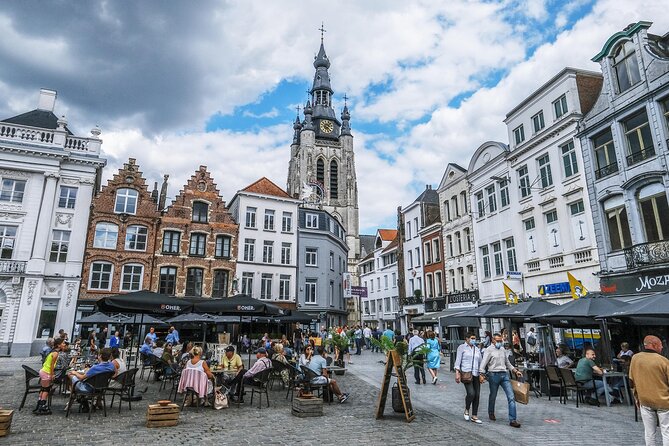
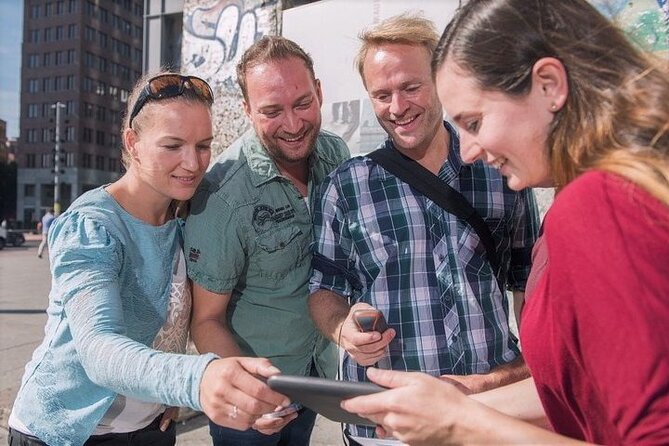
This is not a guided lecture. It’s a city trail you run yourself using an online app on your phone. The experience is private, meaning your group only competes with itself (up to 6 in your group). That matters because you can slow down for details, or speed up when you’re on a roll.
You’ll get a mobile ticket and play the game in English. Duration is roughly 2 to 4 hours, so it fits well as a half-day plan—especially if you like exploring at street level instead of sitting through a rigid tour schedule.
A quick heads-up: the listing location may show Ghent, but the meeting point is in Kortrijk (Stationsplein 6). The stops are also all in Kortrijk. Before you leave, double-check you’re headed to the right city so you don’t lose time on the first hurdle.
You can also read our reviews of more city tours in Ghent


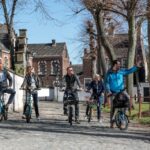
Start at Stationsplein and set your rhythm
The trail starts at Stationsplein 6, 8500 Kortrijk, and it ends back at the meeting point. That back-to-start design is useful: you don’t have to guess how to get home from the final stop. It also makes it easier to plan dinner afterward because you already know where you’ll land.
Your biggest “logistics tool” is the app and your phone. You’ll want your smartphone charged and ready, and you should have internet access because the experience specifically says smartphone and data are not included. If you’re traveling with limited data, plan ahead so the app doesn’t stall mid-trail.
Also, think about how you’ll navigate. Some people found the trail easy once they worked out the phone navigation. Others had trouble when GPS didn’t behave and had to rely on another mapping app. If you like a smooth run, I suggest you arrive near the start spot, get your bearings, and only then start the game.
Beguinage UNESCO zone: 13th-century homes and living courtyards

Your trail’s first anchor is the Kortrijk Beguinage, a UNESCO World Heritage Site since 1998. It dates back to the 13th century, and the experience encourages you to stroll past the small houses and check out the courtyard area. If you like quiet streets where history feels personal, this stop does that well.
There’s also a reference to places you can visit within the beguinage setting, including the Mattheuskapel. The value here is simple: the architecture and layout are easy to appreciate on foot, and the game questions help you notice details you might otherwise miss when you’re just passing through.
One added layer: this beguinage wasn’t always safe. It was destroyed several times (notably in 1302, 1382, and again by the French in 1684), and the 41 cottages date to the 17th century. That kind of history turns the area from pretty to meaningful—especially when your questions connect the site’s survival to Kortrijk’s bigger conflicts.
Where Kortrijk 1302 fits in
Another museum-style stop in the beguinage park zone is Kortrijk 1302, a multimedia museum that deals with myth-making around the Battle of the Golden Spurs. If you don’t want to spend a long indoor session, you may still appreciate the way the game frames the battle story before you see the memorials later on.
Towers, ports of control, and the Lys Valley story
One of the trail’s more technical-feeling clues points to the city’s towers, built with limestone and sandstone. You’ll also hear about the southern Speytorre, built in 1385 to control traffic on the Lys. That’s a great detail to keep in mind while you’re walking, because it explains why certain tower shapes and locations make sense.
The Lys Valley connection is part of what gives Kortrijk its identity beyond churches and monuments. It’s a city shaped by movement—water routes, trade, and the consequences when conflict hits.



Texture museum: flax to linen, with a Lys Valley twist
If your favorite kind of museum is the one that connects daily life to big history, you’ll likely enjoy the Texture stop. It’s described as a museum in Kortrijk about the evolution of flax cultivation, processing, and the path into linen fabric—all linked to the development of the Lys Valley in and around Kortrijk.
Why this works in a scavenger-hunt format: it’s easier to take in a museum when you arrive with a reason to look closer. The game’s questions nudge you to treat the stop as more than a quick exterior glance. And if you’re on a tight schedule, this also gives you a defined “pause point” during your walk.
Church of Our Lady and St. Martin’s Church: worship sites with deep roots
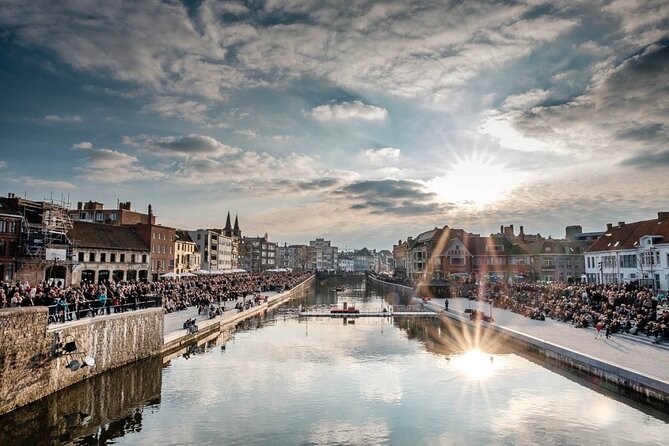
The trail also includes the Church of Our Lady (construction started in 1199 on the initiative of Count Baldwin IX). You’ll also see the idea that the church was located within the grave domain of Kortrijk. Even without going heavy on architectural terminology, that’s the kind of detail that makes a church feel like a record of how a city organized life and death.
Then there’s St. Martin’s Church (Sint-Maartenskerk). The key fact here is that the site hosted a worship place as early as around 650 AD. That’s an easy “wow” moment during a self-guided stroll. It also helps explain why Kortrijk’s religious buildings feel layered: you’re not just looking at one era.
Passionists Church: popular devotion, 19th-century style
Another religious stop is the church of the Passionists, dated 1874 and described as the archetypal church of popular devotion. This is the kind of change-of-era you get in this trail: it’s not locked in medieval time only. It helps your mental map of the city move forward, not just backward.
The Grote Markt power play: belfry, cloth hall echoes, and counts
In the center, you’ll encounter the belfry (Belfort) on the Grote Markt. It used to be part of the former cloth hall, and the earliest mention of the cloth hall goes back to 1248. This is a smart inclusion because it gives you economic history alongside the religious history.
The façade details are also a focus point: the architectural style is described as a Gothic-Renaissance transitional style, and the façade has 14 statues that are filled with figures connected to the counts of Flanders. Even if you don’t identify each statue, you’ll probably enjoy the idea that the building is telling a political story on the outside.
If you’re walking with kids, count-related questions can turn into a quick “find the number” game—just be ready that sometimes a question can hinge on interpretation. One person noted a town hall question about counting Flemish counts wasn’t clear about what exactly to count, and that a Mary statue might have been included unexpectedly. In other words: stay near the location when you answer, and reread the prompt if you think the clue is pointing at a specific figure set.
Groeninge portals and Golden Spurs memorials
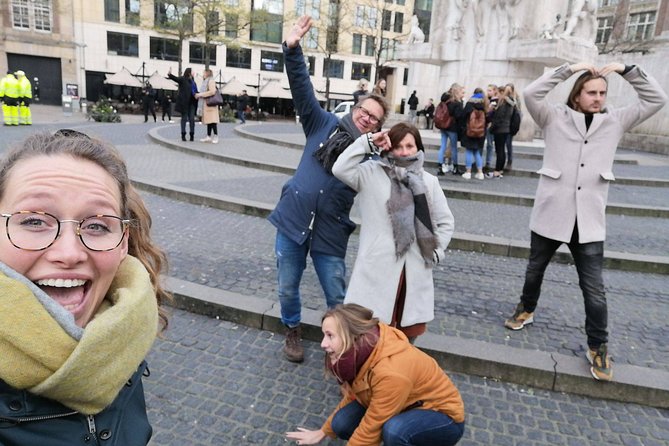
The trail repeatedly nods to the Battle of the Golden Spurs with Groeningepoort and Groeninge Gate / Groeningemonument. The information given is that the triumphal arch was built for the 600th anniversary of the battle, and the gate and monument also commemorate that 600th anniversary.
Why that’s worth your attention: once you’ve seen the beguinage and church origins, you start to realize that Kortrijk’s “main story” isn’t just medieval faith. It’s also conflict, legend, and civic identity made visible in stone.
If you like photo stops but also like meaning, this is a good section. Your game questions act like a mental tour guide: you’re less likely to just snap and move on.
Baggaertshof and the city’s social history in miniature
The Baggaertshof is described as being founded in 1638 by Joossine Baggaert, who set up 13 cottages for needy women. This stop can feel personal because it’s not a castle or a church. It’s social history—how a city tried to care for people within its walls.
In a scavenger-hunt format, it helps to slow down a little and actually look at the scale. Tiny places like this are often where you feel the “human” side of a city’s past.
Gardens, the rose garden, and a calmer pace
Not every clue needs to be about battle or trade. The International Rose Garden dates back to 1959 and is located in the gardens of castle ’t Hooghe along Doorniksesteenweg. If your feet start to feel heavy, a garden stop is an ideal way to reset.
Even though this is a game, you can use it like a walking timer. Take your time here, read what you can, and answer the related question while you sit. It’s the kind of pause that keeps the whole experience from turning into a nonstop sprint.
Shopping centers as part of the route (yes, really)
Two shopping-related stops are part of the trail: K in Kortrijk and Ring Shopping.
- K in Kortrijk is a shopping centre in the heart of Kortrijk with more than 80 shops and restaurants, spread over 34,000 m².
- Ring Shopping is an indoor shopping center on the outskirts with 90 shops.
It might sound odd in a sightseeing-first itinerary, but that’s exactly why it can feel practical. If you’re traveling with mixed interests (or weather is acting up), it gives you a place where you can rehydrate, regroup, or duck inside without losing the flow of the trail.
Hospital courtyard: hospitality, not just illness
The trail includes a preserved 17th-century hospital inner courtyard. It’s described as one of the best preserved 17th-century sites in Kortrijk. The explanation provided is that the word “hospital” (Latin: hospitalis) refers to hospitality, not illness.
This is a meaningful angle for a self-guided walk. It reframes what you might otherwise see as a plain courtyard. When your game questions nudge you to look at the space as a social institution, the atmosphere changes.
Fortifications and war echoes: artillery tower
Near the end of your mental timeline comes the Artillery Tower / Armorie Tower, built with the castle in 1301–1302 by French King Philip the Fair, as part of the Franco-Flemish war against the Count of Vlaandere.
If you’re the kind of traveler who likes to connect city monuments to power struggles, this stop will click. It also helps explain why Kortrijk’s skyline has visible remnants of strategic thinking.
Kortrijk Theatre and everyday culture
One more city rhythm stop is the Kortrijk Theatre, described as among the largest performing arts centers in South-West Flanders. The building dates from 1920 and was conceived as a théâtre à l’italienne.
Why it’s included in a game trail: it widens your sense of Kortrijk beyond museums and churches. It reminds you that cities keep performing long after the medieval chapters end.
Practical tips: GPS, street works, and scoring sanity
Based on real-world issues people have run into, here are the practical things to do before you start (or when you get stuck):
- Pre-plan for navigation gaps. If your GPS struggles, use a second mapping app to confirm where you are. One reviewer had to trace locations via Google and lost points because the game didn’t trigger as expected.
- If construction hides a clue spot, don’t force it. There were mentions of works in Kortrijk making some answers not immediately visible. Treat it like a nature hike: look for the intended landmark edge, not just the closest corner.
- Stay patient at the start. If the route’s next step isn’t obvious immediately, pause and confirm you’re lined up with the spot the app expects before you move on. A few people said the beginning required figuring out how best to work with navigation.
Also, since this is app-based, a quick battery check is worth it. If your phone dies, your game dies.
Who should book this e-Scavenger hunt in Kortrijk?
This is a great fit if you want:
- A flexible plan with no fixed guide timing
- A learning angle that comes via questions at real locations
- A family-friendly walk, since many prompts are described as suitable for children
- A way to explore Kortrijk in small-team energy. People enjoyed the excitement of playing in teams.
It’s less ideal if you:
- Hate phone-based navigation games and prefer “follow a person” tours
- Have limited internet and can’t get data on your device
- Want a strict, guided explanation at every stop (this is more self-led than lecture-led)
Should you book this in Kortrijk?
If you like wandering while still learning something, I think this trail offers good value. You’re paying about $37.33 per group up to 6, for a multi-stop walk that hits major anchors like the UNESCO Beguinage, Golden Spurs memorial areas, and a museum focused on flax and linen. With a duration that stays in the 2–4 hour window, it’s easy to pair with lunch and an extra walk.
My decision rule: book it if you have a charged phone, you’re okay doing a game with occasional navigation fuss, and you want to explore Kortrijk on your terms. Skip it if you expect a fully guided narrative or you know your GPS tends to fail.
FAQ
How long is the e-Scavenger hunt in Kortrijk?
It takes about 2 to 4 hours, depending on how long you stop at each location.
How much does it cost and how many people can join?
It’s $37.33 per group (up to 6 people).
What do I need on my end?
You need your smartphone and data. The experience provides the online app for playing the game, plus a mobile ticket.
Is this self-guided or do I get a guide?
It’s self-guided. You play the city trail using the app, and the activity is private for your group.
What language is the experience offered in?
The game is offered in English.
Can I cancel for free?
Yes. You can cancel for a full refund if you cancel at least 24 hours in advance. If you cancel less than 24 hours before the start time, the amount paid is not refunded.