REVIEW · ANTWERP
Antwerp: walking through history
Book on GetYourGuide →Operated by Antwerp Anytime · Bookable on GetYourGuide
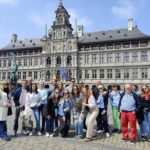
Antwerp’s past walks right alongside you. This 2-hour private tour strings together the city’s key turning points, starting on the Grote Markt and moving step by step toward where commerce, faith, and art reshaped the place. I like that the story is delivered in English and Dutch, so you’re not left doing guesswork in a country where street signs are only half the battle.
Two things I’d call out fast: first, the guidance is strong and practical, with guides who tell the history clearly and with energy, including well-regarded guides like Filip de Meester, often known as Flip. Second, the route isn’t just sightseeing for postcards. It follows a timeline you can actually track, from the early town wall and guild life to the Baroque era and the money side of Antwerp.
One possible drawback: this is still a walking tour, so if rain and wind roll in, you’ll feel it. I’d plan on weather gear, because the route covers outdoor streets between stops, and you’ll want to keep your comfort up for the full 2 hours.
In This Review
- Key highlights you’ll actually use
- Grote Markt: where your Antwerp timeline starts
- Down to the Scheldt and the first town walls
- Guild power at the Vleeshuis: butchers, money, and status
- Religious strife and how it changed what you see
- Carolus Borromeus Church: the Baroque turning point
- Stock Exchange hopes and the Gothic cathedral pass-by
- Plantin&Moretus garden: printing, publishing, and long influence
- Guide quality: clear storytelling with room for individual needs
- Accessibility and comfort: prams and wheelchairs are considered
- Price and value: $106 for a focused private 2-hour story
- Timing: how to get the best day out of your 2 hours
- Weather reality: rain and cold can’t be ignored
- Who this walk suits best
- Should you book Antwerp: walking through history?
- FAQ
- How long is the Antwerp historic walking tour?
- Where does the walk begin?
- What languages are available?
- Is the tour suitable for wheelchair users and prams?
- Is it a private group?
- Is pickup included?
- Can we enter churches and museums during the tour?
- Does the stock exchange always allow entry?
- What’s the cancellation and payment flexibility?
Key highlights you’ll actually use
- Grote Markt start: you get orientation instantly, then the walk builds outward from the city’s main square
- Scheldt + first fortifications: you trace where Antwerp’s early growth began and why walls mattered
- Vleeshuis (butchers’ guild house): a strong anchor point for understanding guild power and daily business
- Carolus Borromeus Church: the walk marks the switch to a new art style and era
- Stock Exchange area + Gothic cathedral pass-by: you aim for interiors when timing allows, then end near the Plantin&Moretus museum garden
- Wheelchair and pram friendly: the tour is designed to work for mobility needs, not just able-bodied walkers
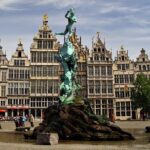
Grote Markt: where your Antwerp timeline starts
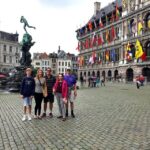
Most walking tours in historic cities begin with a random street corner. This one starts where Antwerp makes you feel grounded right away: the Grote Markt (Grand Place). You begin there with a quick overview, which matters more than it sounds. When you understand what you’re looking at before you start walking, the whole route clicks faster.
You’ll also be better prepared for what comes next. The Grote Markt isn’t just a pretty start; it’s a social and political center. From there, the guide can explain how the city grew outward and how later power centers took over. If you only have a short window, this start helps you get the big map in your head quickly.
What to watch for: spend a moment orienting yourself at the square before you move on. Even if you don’t read every façade detail, spotting the general layout helps you enjoy the later “before and after” contrasts.
You can also read our reviews of more walking tours in Antwerp

Down to the Scheldt and the first town walls
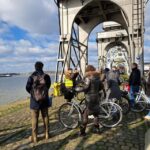
From the square, you head toward the river Scheldt, where the story starts in a very literal way: water means movement, trade, and wealth. The guide ties that geography to why the early town formed and how Antwerp’s boundaries took shape.
Then comes the part that makes this walk feel like a lesson without being boring: you reach the fortifications of the first town. You’re not just hearing words about old defenses. You’re walking in a way that helps you picture what it meant to live with walls and controlled entry points.
As you follow the city’s expansion, you’ll move along the remaining parts of the first city wall. That change from “where the town ended” to “where it grew next” is one of the best ways to understand Antwerp’s long development. Cities expand in phases, and the wall is one of the clearest physical clues.
A practical tip: wear shoes with good grip. Even when the sidewalks look flat on the map, historic-city streets can have slick patches after rain.
Guild power at the Vleeshuis: butchers, money, and status
One of the smartest moments on the route is when you reach the oldest and largest guild house, the Vleeshuis, known as the butchers’ guild house. This is where Antwerp’s economy becomes human. Guilds weren’t abstract. They were the kind of organizations that could shape who had influence, what got built, and how wealth was displayed.
The guide follows the timeline from this early corporate life toward later power. That transition is key because Antwerp’s identity isn’t only about one era. It’s about how older systems fed into newer centers of wealth and decision-making.
Why I like this stop: it helps you see Antwerp as more than architecture. You start to understand why certain buildings matter and why they were designed to impress.
Religious strife and how it changed what you see
After the guild and early city-growth section, the walk moves into the 16th century religious strife and the consequences that followed. This is the kind of topic that can turn dry fast, but on this tour it’s handled as part of the city’s cause-and-effect story.
You’ll connect political and social tension with the way religious conflict ripples into everyday life, public behavior, and artistic taste. Even if you don’t know Antwerp’s details before you start, the guide’s framing gives you a clear way to follow what changed and why you should care.
What you’ll notice as you walk: the route doesn’t treat religion as a “topic of the day.” It sets up the next visual shift in style and taste.
Carolus Borromeus Church: the Baroque turning point
Then you arrive at a major marker of a new era: the Carolus Borromeus Church. The tour links this stop directly to the shift into Baroque art and the kind of grandeur that grew from that cultural moment.
Baroque can feel like just decoration if you’ve never learned how to read it. Here, the guide uses it as a narrative checkpoint. You’re not only seeing a church. You’re watching Antwerp change its visual language, responding to its own historical pressures.
Good to know: churches can have schedules. The tour is designed to work with that reality by focusing on what’s open and accessible at the time of your visit.
You can also read our reviews of more historical tours in Antwerp

Stock Exchange hopes and the Gothic cathedral pass-by
Next comes Antwerp’s financial symbol, the area of the Stock Exchange. You’ll hear it described as the mother of all stock exchanges, and the guide adds context about Antwerp’s role as a commercial hub.
The tone here is honest: you’ll make the attempt to enter, but it depends on whether the door is open for the moment you arrive. That’s normal with historic public buildings, and the tour handles it without derailing the whole experience. Even if you can’t get inside, you’re still walking the storyline: from walls and guild houses to the financial heart of the city.
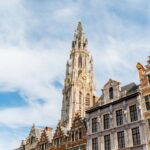
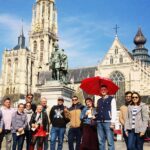
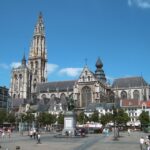
On the way to the final destination, you also pass the biggest Gothic cathedral in the Low Countries. Even though you may not spend lots of time standing there, it’s a useful visual contrast. The Gothic scale makes the city’s “big ambitions” feel real.
If you care about interiors: aim for flexibility. This tour is set up so you still get value even when access is limited by the schedule on the day.
Plantin&Moretus garden: printing, publishing, and long influence
You end in the garden of the Plantin&Moretus museum, tied to a 16th-century printing and publishing house that stayed in the same family ownership until the late 19th century. This is a strong finish because it shifts the focus from politics and money to ideas and communication.
Printing and publishing were engines of cultural change. When you finish here, Antwerp doesn’t just feel old. It starts to feel consequential. You can leave thinking about how knowledge spread, how people argued, and how what was printed helped shape what later generations believed.
What makes this ending work: it’s calmer than a busy shopping street, so you get a moment to let the story settle. After 2 hours of contrasts, that garden finale gives your brain a place to land.
Guide quality: clear storytelling with room for individual needs
The tour stands or falls on the guide, and this one has a reputation for doing it right. The names you might hear in the group often include Filip de Meester (Flip), and the common thread is delivery: warm, engaging, and usually sprinkled with humor. That matters because Antwerp history has plenty of twists, and you want a guide who keeps the threads straight.
You’ll also appreciate the pacing. On this kind of walk, the best guides explain just enough at each stop so you don’t get lost, then move you forward at a rhythm that fits real people. Some guides even adjust to individual preferences, taking time when someone needs it and keeping the whole group moving without rushing.
If you want a tour that teaches you how to look at a city, not just where to stand for photos, this is the style to choose.
Accessibility and comfort: prams and wheelchairs are considered
A big plus for this walk is that it’s wheelchair accessible and also works for parents with prams. That’s not a throwaway line. It changes how the tour is planned: routes, stop timing, and how you move between points of interest.
If you’re traveling with mobility needs, don’t assume you’ll have to do a “lighter version.” Here, the plan is built for you to be included in the main route, not parked at the sidelines.
My practical advice: still bring a little buffer for slower moments. Even when a route is accessible, the best experience happens when you’re not rushing your body through turns and transfers.
Price and value: $106 for a focused private 2-hour story
The price is listed as $106 per group, with the activity noted as private and up to 1 participant for that rate. In plain terms, you’re paying for the flexibility and attention of a guide who can keep the story tight, in your preferred language, and tuned to your pace.
Is it expensive for a walking tour? It can be, depending on how you compare. But the value comes from what you get bundled in:
- A guided route that’s organized like a timeline, not random stops
- Live interpretation in Dutch or English
- Pickup included, so you’re not spending your first 20 minutes figuring out where to meet
- The chance for free entry to some churches and museums, plus the stock exchange area when conditions allow (and when there’s no mass or event scheduled)
When you add those factors up, this is less about “cheap sightseeing” and more about a guided history experience that respects your time. If you’re the type who wants the city explained clearly, the cost starts to feel more reasonable.
Timing: how to get the best day out of your 2 hours
Duration is 2 hours, which is a sweet spot. It’s long enough to make a meaningful circuit through major themes, but short enough that you won’t feel trapped if the weather turns or your energy dips.
The schedule also matters for entry points. Some venues allow access for free only when there’s no mass or event. That means your plan should treat the interior visits as a bonus, not the entire goal.
Smart move: choose a time when you’ll be comfortable walking outdoors for most of the route. If you hate cold wind, don’t pick the last slot before sunset.
Weather reality: rain and cold can’t be ignored
Antwerp weather is unpredictable. Even with a great guide, you’re still walking between historic sites outdoors. The tour is good in bad conditions, but comfort is still your job.
Bring:
- A light rain layer or umbrella you can manage while walking
- A warm layer if you’re going in cooler months
- Shoes that won’t slip
A good guide will keep the story flowing and keep you moving at a safe pace, but you’ll enjoy it more if you dress for the street.
Who this walk suits best
This tour is a strong fit if you:
- Want a timeline of Antwerp, not a list of sights
- Prefer history explained clearly in English or Dutch
- Like architecture but also care about the people behind it (guild life, religious shifts, commerce)
- Need an option that supports wheelchairs and prams
- Want a smaller, more flexible experience through a private group
If you want a long, free-form wander where you hop from place to place on your own, you might find 2 hours feels structured. But if you want smart direction and context, it’s the right length.
Should you book Antwerp: walking through history?
Yes, if you want your Antwerp visit to feel organized and understandable quickly. The combination of a bilingual, engaged guide, a route built around major turning points, and an ending at the Plantin&Moretus garden makes this tour a high-efficiency way to learn the city.
Book it especially if you care about how Antwerp went from early walls and guild power to religious change, Baroque style, and the financial heart. And if you’re traveling with accessibility needs, it’s one of the more thoughtful options because the tour is designed to include you, not exclude you.
If you hate walking or you’re only interested in one single monument, you might choose a shorter, more focused plan. Otherwise, this is a very solid use of 2 hours.
FAQ
How long is the Antwerp historic walking tour?
The tour lasts 2 hours.
Where does the walk begin?
It starts at Grote Markt in Antwerp.
What languages are available?
The live guide speaks Dutch and English.
Is the tour suitable for wheelchair users and prams?
Yes, the tour is described as wheelchair accessible and suitable for parents with prams.
Is it a private group?
Yes, it’s listed as a private group.
Is pickup included?
Yes, pickup is included. You’ll need to contact the guide to arrange where to be picked up.
Can we enter churches and museums during the tour?
You may get free entry to some churches and museums, and also the stock exchange area, as long as there is no mass or event scheduled.
Does the stock exchange always allow entry?
No guarantee is mentioned. The tour notes that the door may open depending on circumstances.
What’s the cancellation and payment flexibility?
You can cancel up to 24 hours in advance for a full refund, and there’s an option to reserve now & pay later.