REVIEW · BRUSSELS
e-Scavenger hunt Leuven: Explore the city at your own pace
Book on Viator →Operated by Qula · Bookable on Viator
Leuven can turn into a game fast. This self-guided e-scavenger hunt is built around an interactive city game you run on your phone, so you choose the pace and the stops. You’ll hit big sights like the Town Hall, but the real win is the freedom to pause, snack, and keep going when your group is ready.
I particularly like the flexible timing and the way the route mixes famous landmarks with smaller places you might otherwise skip. It’s also easy to treat as a half-day plan, because the app includes about 2.5 hours’ worth of content.
One thing to think about: a smartphone is required, and smartphone and data are not included. If your phone battery is low or your connection is spotty, bring a power bank and plan accordingly.
In This Review
- Key highlights worth knowing
- How the e-Scavenger hunt in Leuven really feels: game first, sightseeing second
- Starting at Monseigneur Ladeuzeplein 17: where your Leuven walk begins
- Grand Place and Leuven Town Hall: the big Gothic moment you reach early
- Oude Markt and the long-bar feeling: eating and walking at the same time
- Beguinages in two scales: the old beguinage and the Klein Begijnhof
- Herb Garden Leuven (Hortus Botanicus Lovaniensis): a calm reset in the middle of the hunt
- University Library and Leuven as a long-running university town
- Stella Artois brewery: local pride tied to a global brand
- St. Peter’s Church and the Romanesque-to-medieval story you can actually see
- St. James tower and the seven-wonders detail that gives you something to hunt for
- Sint-Gertrui: a medieval parish church outside the first city wall
- Romanesque gate and city-wall towers near the water: Leuven’s edges still tell stories
- How long the hunt takes, and how to pace it without losing the fun
- Who this e-Scavenger hunt is best for
- Should you book e-Scavenger hunt Leuven?
- FAQ
- Is this a guided tour with a person?
- What language is the e-scavenger hunt offered in?
- How long does the experience take?
- How much content is included in the app?
- Where do we start the hunt?
- Where does it end?
- What’s the maximum group size?
- Do I need a smartphone or data?
- Is it available every day?
- Is it wheelchair-related or hearing-impaired friendly?
- Can I cancel for free?
Key highlights worth knowing

- A game, not a guided lecture: you solve clues and answer prompts as you walk
- About 2.5 hours of app content: ideal for a focused half-day
- Private group of up to 6: one team, one experience, your pace
- Leuven landmarks plus side streets: major squares and quieter corners get equal attention
- English mobile ticket: you can start and stop whenever you need
- Great for “stop for a terrace” breaks: the format doesn’t force you to march nonstop
How the e-Scavenger hunt in Leuven really feels: game first, sightseeing second
Think of this as sightseeing with a mission. You’re not following a person with a microphone. Instead, you’re following prompts on your phone as you move around Leuven. That means the experience is more about attention and curiosity than it is about sitting still.
The format works well if your group has mixed interests. One person loves architecture, another wants quick facts, and someone else just wants something fun to do outside. Because it’s self-paced, you can linger when you find a detail worth reading, and skip ahead when you don’t. The app’s content is designed to keep things moving without feeling like a nonstop checklist.
Your team size is capped at 6, which is a sweet spot. In a small group, clues feel collaborative instead of chaotic. And because it’s private, you won’t be trying to keep up with strangers while your phone buzzes with the next task.
The main practical caveat is simple: you need your phone and access to the app experience. Since smartphone and data are not included, I’d plan to arrive with battery to spare and a workable data connection.
You can also read our reviews of more city tours in Brussels



Starting at Monseigneur Ladeuzeplein 17: where your Leuven walk begins
Your meetup point is Monseigneur Ladeuzeplein 17, right in central Leuven. This matters because it sets you up for a route that’s easy to understand once you’re on the move. You start the hunt in a part of the city where you can quickly get your bearings and then expand outward toward the core sights.
This area also links nicely to Leuven’s identity as a student and university city. You’ll later visit the University Library on Ladeuzeplein, described as a beautiful heritage building. Starting here makes that connection feel natural instead of random.
If you’re arriving by public transportation, the start point is listed as being near transit. That’s useful because you don’t have to build your whole day around a long commute just to begin the game.
Grand Place and Leuven Town Hall: the big Gothic moment you reach early
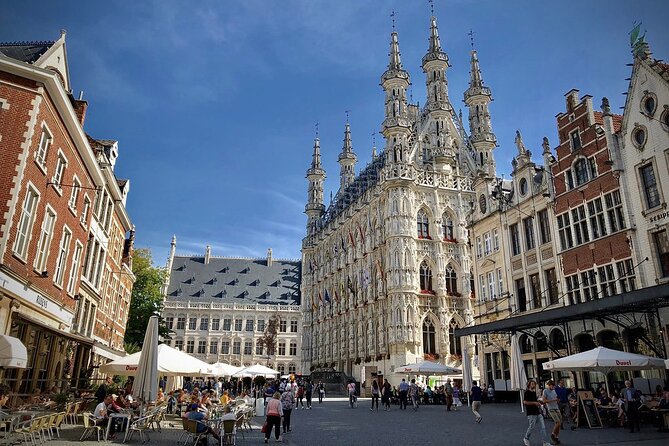
You’ll be directed to Leuven Town Hall on the Grand Place. This is one of the most famous Gothic town halls in the world, and the square setting makes it an easy place to anchor your orientation. Even if you don’t think of yourself as a Gothic fan, Town Halls like this do something to a city square: they make the whole space feel important.
Here’s what I like about hitting it as a game stop. You’re not waiting until the end of your day for the main attraction. You’re meeting it while your energy is still high, and you can compare what the game tells you to what you see. It makes the architecture feel like information you earned, not a label someone handed you.
The Grand Place also ties into Leuven’s trading past. The city’s market law dates to 1150, and markets were held up to three times a week. When you’re in this area during the hunt, it helps to imagine the square as a lively schedule, not just a photo spot. You can almost picture daily rhythm: merchants, chatter, and the kind of crowd flow that shaped the streets.
Oude Markt and the long-bar feeling: eating and walking at the same time
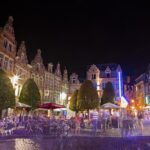
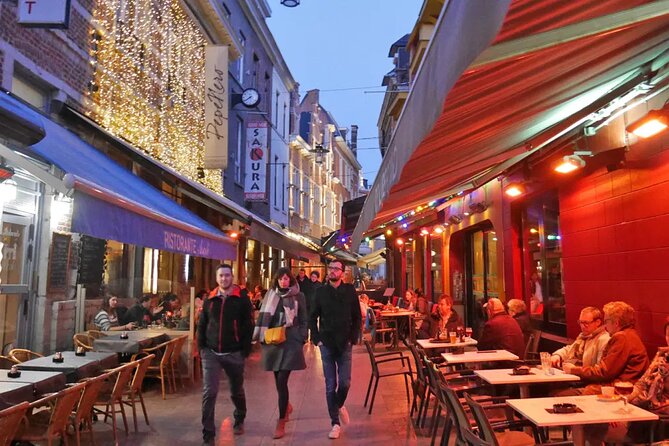
Next up is Oude Markt, described as the longest bar in Europe because of how many catering spots cluster there. That phrase is doing real work for your planning. It tells you that this is one of the best places to take a break without going far off your route.
The game structure helps here. If you reach Oude Markt and your team wants a drink or snack, you don’t feel like you’re derailing a tight walking tour. You can stop, regroup, and resume when you’re ready.
I also like that the hunt keeps the experience outdoors and self-directed. It’s not just about points and puzzles; it’s about using the walk to experience Leuven’s public life—especially in places where food and conversation are part of the city’s rhythm.
Beguinages in two scales: the old beguinage and the Klein Begijnhof
Leuven is famous for beguinage communities, and the hunt gives you two different perspectives.
First, you visit the beguinage that dates back to the 13th century. During its heyday in the 17th century, about 360 beguines lived there. That number is a clue in itself. It helps you read the space not as a quaint relic, but as a real community that once held a big slice of women’s daily lives.
Second, you’ll find the Klein Begijnhof, first mentioned in 1272. It’s described as a small district made up of a street and two cul-de-sacs, linked to women connected with Sint-Geertruiabdij. This one feels more intimate because the layout is tighter and the story is more specific.
When a city game includes both, you get a useful comparison. You can see how the idea of a beguinage changes in scale and organization over centuries. It also gives you a chance to notice how Leuven’s old neighborhoods still have a human-sized feel when you’re walking through them.






Herb Garden Leuven (Hortus Botanicus Lovaniensis): a calm reset in the middle of the hunt
At some point, you’ll want a slower pace. The hunt includes Herb Garden Leuven, listed as the oldest botanic garden in Belgium. The official name is Hortus Botanicus Lovaniensis.
This is a smart inclusion because gardens aren’t just scenic here. They change how you walk. The hunt helps you shift from quick navigation to observation—seeing how living collections are arranged and imagining how a botanic garden would support learning in earlier centuries.
Also, it breaks up the heavier architecture stops. If your group has kids, it can be a welcome moment to stretch legs and slow down without losing momentum.
University Library and Leuven as a long-running university town
Leuven’s education story is a big part of its character, and the hunt leans into it. The University Library on Ladeuzeplein is highlighted as a beautiful heritage building, which makes it a strong anchor stop in the middle of your route.
The city’s university connection is described as dating to three successive universities almost continuously since 1425. You don’t need a lecture to appreciate what that means. In practice, it suggests a steady stream of students, scholars, printing and books, and the kind of long-term investment that shapes streets and institutions.
If you like travel that explains why cities feel the way they do, this part gives you that context. Even if the game keeps the facts short, you still leave with a clearer picture of Leuven beyond its buildings.
Stella Artois brewery: local pride tied to a global brand

One of the more distinctive stops on the hunt is the brewery of Stella Artois, described as still firmly rooted in its home city of Leuven. It’s also noted as part of the AB InBev group, which helps you connect the local identity to the global beer world.
This stop works for different types of travelers. Beer lovers get the satisfaction of learning where a famous brand lives. History-minded people get a sense of how industry and city identity overlap. And if you’re simply walking through Leuven with a playful mission, it adds variety so the day doesn’t feel like only churches and courtyards.
Just remember: the hunt frames it as one more clue point on a walking game. You’re not signing up for a full brewery tour described in the information given, so treat it as part of the broader city story.
St. Peter’s Church and the Romanesque-to-medieval story you can actually see
Leuven includes churches in several styles, and the hunt uses them well to create a timeline effect.
St. Peter’s Church is described as located in the heart of Leuven, built in 986 in Romanesque style, and noted as the oldest church in the city. That’s the kind of detail that changes how you see a building. If you know it’s older and Romanesque, you’re more likely to look for the heavy, rounded feel and older construction patterns rather than just admiring it as a pretty façade.
You’ll also see an architectural description in your route notes: construction around 1440, with a church layout described as having 2 strongly protruding transepts and a heptagonal apse, among other elements. Even if the exact wording is imperfect, the key takeaway for your visit is this: the building’s plan gives you visible structure, and you can spot those major shape features as you move around it.
The practical advantage of church stops in a self-guided game is timing. If you reach a church when it’s busy or quiet, you can adapt. The hunt doesn’t trap you on a schedule the way a guided tour might.
St. James tower and the seven-wonders detail that gives you something to hunt for
Another stop brings you to the Romanesque Church of St. James from the beginning of the 13th century, with the note that only the tower remains. That’s a big idea for a city game: it teaches you that old buildings don’t always survive whole, but parts do—and those parts can still carry meaning.
The tower includes an ornate bell from 1478, described as one of the seven wonders of Leuven. This is exactly the kind of detail that makes a hunt satisfying. You’re not just walking past a landmark; you’re on the lookout for a specific feature tied to a local legend.
If your group loves a bit of friendly competitiveness, this is the sort of stop that makes the puzzle feel rewarding when you get the right answer.
Sint-Gertrui: a medieval parish church outside the first city wall
The hunt also includes the former abbey church Sint-Geertrui. It’s described as one of the five medieval parish churches in Leuven, and it’s located outside the first city wall, between the Dijle and the Mechelsestraat.
That location detail matters because it helps you picture the medieval city boundary, not just the present-day center. When you’re in the area, try to think about what it would have meant to be outside the wall: different foot traffic, different defenses, and a different relationship to the city’s core.
This stop rounds out the church section by giving you variety in both setting and story. The hunt keeps you moving, but it also gives you the mental tools to connect each stop to how the city grew.
Romanesque gate and city-wall towers near the water: Leuven’s edges still tell stories
Not every great city game stays in the thick of the center. This one pushes you toward reminders of older city boundaries.
You’ll visit a Romanesque gate dating from 1218 to 1222, described as the only remnant of the Sint-Elisabethgasthuis, founded around 1080 to 1090 under Henry III, Count of Leuven. Even if you don’t know the names going in, the hunt gives you a framework: this gate is a surviving fragment. That makes it easier to care about a structure that might otherwise be easy to miss.
Then you’ll head to Janseniuspark to see the Jansenius and Justus Lipsius tower. They’re described as flanking the water gate in the Middle Ages, the place where ships entered Leuven. This is one of those moments where a city game quietly teaches you geography: the city wasn’t just streets and squares; it was also movement of goods by water.
If you like your travel days to include at least one “pause and look around” moment, this section provides it. The towers and water-gate story help you slow down and scan the surroundings for connections rather than just speed-walking to the next stop.
How long the hunt takes, and how to pace it without losing the fun
The duration is listed as 2 to 4 hours, and the app includes about 2.5 hours’ worth of content. That’s a helpful match because it gives you a realistic expectation: even if you move efficiently, you can still stop to read and enjoy.
Because start and stop timing is flexible, you can treat this like a choose-your-own-adventure half-day. If your group wants a coffee break, schedule it. If you’d rather keep momentum, do that too. One useful approach is to aim to finish the main clues within the 2.5-hour content window, then use the remaining time to linger in your favorite squares.
The activity is open every day from 12:00 AM to 11:59 PM. In plain terms, that means you can fit it around the rest of your day. I’d still pick a time when you can enjoy walking outdoors comfortably, especially since much of the fun is simply moving through Leuven.
Who this e-Scavenger hunt is best for
This works especially well if you want a light structure and a playful challenge.
- Families with older kids can join in, since the format supports participation without requiring advanced reading skills.
- People who like exploring at their own pace will appreciate the flexible stops.
- Groups who want low-pressure fun will find the game structure keeps energy up without forcing everyone to stick together at every second.
It’s also a good choice if you like a little friendly competition. The tasks are designed to be answered and solved as you go, so the hunt naturally creates that spirit.
The main mismatch is for people who want a full-on guided commentary or a guided walk with a person explaining everything. This is intentionally built to be your pace, driven by phone prompts, not a storyteller.
Should you book e-Scavenger hunt Leuven?
If you’re spending half a day in Leuven and you want to see both the headline sights and lesser-noticed corners, I think this is a smart booking. The value per group is strong too: it costs $37.21 per group up to 6, which can work out to about $6.20 per person when you fill the group.
The biggest decision point is your comfort with a smartphone-based experience. If you’re ready to use your phone and keep it charged, you’ll likely enjoy the freedom, the quick facts, and the way the route makes you look twice at places like the Town Hall, beguinages, historic gates, and the church towers.
If you want, tell me your travel month and group size, and I’ll suggest a best time-of-day plan and how to split the hunt into breaks around Oude Markt and the garden stop.
FAQ
Is this a guided tour with a person?
No. It’s a self-guided city game you run at your own pace using the mobile experience.
What language is the e-scavenger hunt offered in?
It’s offered in English.
How long does the experience take?
Plan for 2 to 4 hours.
How much content is included in the app?
The app includes about 2.5 hours’ worth of content.
Where do we start the hunt?
The start point is Monseigneur Ladeuzeplein 17, 3000 Leuven, Belgium.
Where does it end?
The activity ends back at the meeting point.
What’s the maximum group size?
It’s priced per group for up to 6 people.
Do I need a smartphone or data?
A smartphone and data are not included, so you’ll need your own phone and to be able to use the app.
Is it available every day?
Yes. It lists opening hours Monday to Sunday, 12:00 AM to 11:59 PM.
Is it wheelchair-related or hearing-impaired friendly?
It says user-friendly for hearing impaired and that most travelers can participate. It also lists that service animals are allowed.
Can I cancel for free?
Yes. You can cancel for a full refund up to 24 hours in advance.