REVIEW · BRUGES
Bruges Walking Tour with Audioguide on Your Smartphone
Book on Viator →Operated by TouringBee · Bookable on Viator
A 1-hour walk can still feel like Bruges. This self-guided Bruges route strings together big sights and calmer corners with 21 smartphone audio recordings you can play on your schedule. You start at Poertoren (Gunpowder Tower) and loop back the same way, with an offline map to keep you moving.
I like two things most. First, the offline map and GPS-friendly route make it easy to find each stop without babysitting a group. Second, the audio is built for short, focused visits, so you get history, traditions, and practical orientation without needing a human guide.
One caution: you need to plan for the small stuff. You bring your own headphones, and one review noted occasional playback hiccups—so I’d keep your phone charged and be ready to restart your flow if audio cuts out.
In This Review
- Key highlights before you go
- Why this Bruges audio walk fits the city
- Price and what you’re really paying for ($8.41)
- What’s included (and why it matters on cobblestones)
- Before you start: set up your TouringBee audio guide
- The walking route: Poertoren to Belfort in about an hour
- Stop 1: Poertoren Tower for big views fast
- Stop 2: Minnewater Lake, the Lake of Love, with a calm break
- Stop 3: Princely Beguinage Ten Wijngaarde (UNESCO) for everyday medieval life
- Stop 4: St. John’s Hospital for art in a care setting
- Stop 5: Church of Our Lady for Michelangelo’s Madonna and Child
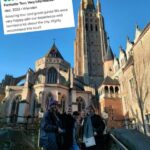
- Stop 6: St. Salvator’s Cathedral for Gothic atmosphere and a tower option
- Stop 7: Boniface Bridge for canal views and a breather
- Stop 8: Burg Square for the civic heart of Bruges
- Stop 9: Basilica of the Holy Blood for a sacred relic stop
- Stop 10: Belfort for panoramic views and carillon sounds
- Who this smartphone audio tour is best for
- When it might not be your best match
- Should you book this Bruges audio guide walk?
- FAQ
- Is this tour self-guided?
- How long is the Bruges walking tour?
- Where do I start, and where does it end?
- What do I need on my phone to use the audio guide?
- Do I need to bring headphones?
- What language is the audio guide offered in?
- Are entrance tickets included for the stops?
Key highlights before you go

- Offline map + route so you can navigate with less stress and fewer dead ends
- 21 audio recordings that cover sights, history, and traditions as you walk
- UNESCO stop at Ten Wijngaarde to see how the beguinage shaped everyday medieval life
- Hospital + art stop at St. John’s Hospital and its Memling connection
- Iconic viewpoints at Poertoren and Belfort (with tower climbs called out)
- Smartphone ticket with a one-year app access window
Why this Bruges audio walk fits the city
Bruges is made for walking, but it can also make you feel like you should be studying all day. This tour solves that problem by giving you a tight loop of must-sees and “slow-down” moments—so you can actually enjoy the streets, not just read about them.
Because it’s self-guided, you choose your pace. That matters in Bruges, where one extra photo stop can eat up time, and where crowds rise and fall through the day. With audio coming in small segments, you can press pause, take a look around, then continue when you’re ready.
You can also read our reviews of more walking tours in Bruges

Price and what you’re really paying for ($8.41)
At about $8.41 per person for a 1-hour route, you’re mostly paying for convenience and clarity. You’re not paying for a staff-led experience here—there’s no human guide—so the value is in the app setup and the quality of the information you receive while walking.
The package includes: the TouringBee audio guide app for iPhone and Android, offline map navigation, and illustrations to help you recognize landmarks. It also includes one year of access in your chosen language. That’s a practical deal if you might revisit Bruges later, or if you want the option to replay parts on a second trip.
What’s included (and why it matters on cobblestones)
Here’s what you should expect to get, and why it matters in real life:
- Mobile ticket + phone app access: you handle everything in your own time.
- Offline map with route: Bruges streets can be tricky, and roaming charges are not fun.
- 21 audio recordings: you’re not stuck with a long lecture—each segment is built around a stop.
- Illustrations: when you’re standing on a corner with several similar medieval facades, simple visual cues help.
- Headphone-reliant audio: you control volume and pace, but you must bring your own.
The big benefit is that you’re not forced into a rigid group schedule. If you want five minutes at a bridge and ten more minutes in a church, you can do that.
Before you start: set up your TouringBee audio guide
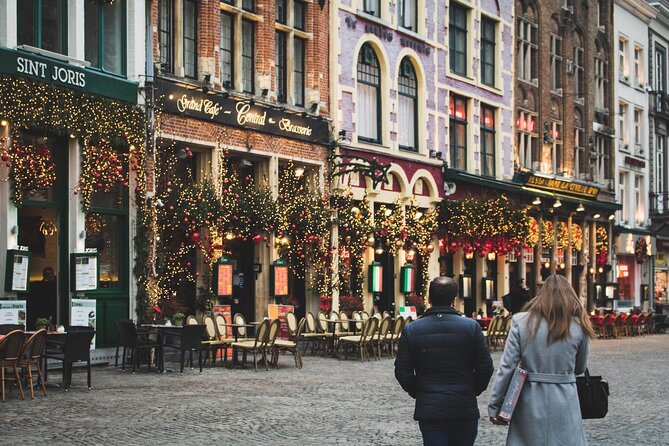
This is a true “download and go” experience. You’ll need to install the TouringBee app on your phone, activate your purchase, and then follow the route on the mobile map.
A tip based on user feedback: make sure you’ve downloaded the app first, before you arrive where the walking begins. The easier your setup is at home or right when you land, the more time you spend enjoying Bruges instead of troubleshooting Wi-Fi.
Also, bring your own headphones. They are not included, and the tour will be a lot less enjoyable without them. Finally, because the tour is time-efficient (about an hour), keep an eye on battery life and phone storage. Offline maps help, but they still eat some power.
The walking route: Poertoren to Belfort in about an hour
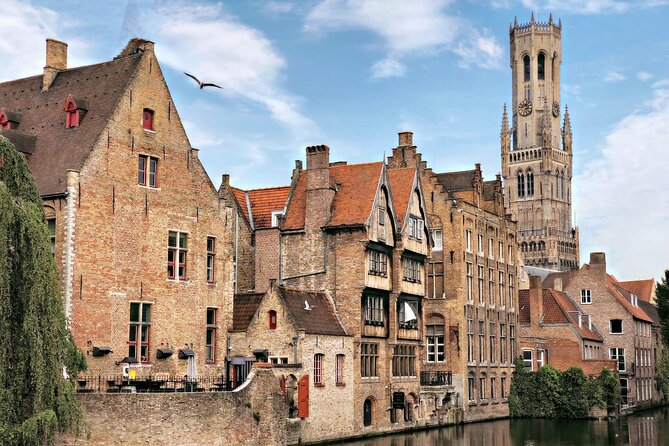
The tour starts at Gunpowder Tower (Poertoren), Begijnenvest 1, and ends back at the meeting point. With the stops paced around roughly 10 minutes each, you’re looking at a brisk but doable loop—especially if you’re the kind of traveler who likes seeing a lot without staying glued to any one spot for ages.
Below is what you can expect at each highlighted stop, plus the practical take on why each one belongs on the route.
You can also read our reviews of more tours and experiences in Bruges

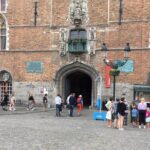

Stop 1: Poertoren Tower for big views fast
You begin with Poertoren Tower (Gunpowder Tower), a medieval brick watchtower right in the center of Bruges. This is the kind of place where the audio does two jobs at once: it gives you context for the tower, and it frames what you’ll notice from above.
If you climb, you get the payoff: a panorama that helps everything else in your walk make sense. Even without a climb, the exterior is a useful landmark—so it’s a smart start point for orienting yourself in the city.
Practical consideration: tower climbing can cost extra in some places, and entrance fees/tickets are not included in the tour package. So if the climb is on your must-do list, be ready to pay separately if needed.
Stop 2: Minnewater Lake, the Lake of Love, with a calm break
Next up is Lake Minnewater, also called the Lake of Love. This is where Bruges shifts from high-energy sightseeing to slower strolling. The walking path and the small bridge make it easy to pause, look at the water, and reset your brain before more churches and squares.
The audio framing here matters: it doesn’t just point at the scenery. It ties the area to legend and gives you a reason to notice the details—like how the tree-lined paths guide your movement and how the swans fit into the setting.
This is also a good stop if you’re traveling solo. You can enjoy the atmosphere without feeling rushed.
Stop 3: Princely Beguinage Ten Wijngaarde (UNESCO) for everyday medieval life
Then you reach The Princely Beguinage Ten Wijngaarde, a UNESCO-listed beguinage that feels quiet even when the streets nearby are busy. The audio helps you understand what you’re looking at: white-washed buildings, garden spaces, and a layout that reflects medieval simplicity.
This stop is one of the best “slow” sections on the route because beguinages don’t work like classic monuments. They’re more about how space supports a way of living. If you like places where life happened over centuries—not just a single event—this one clicks.
Practical consideration: it’s easy to take a longer-than-planned look here. With the tour targeting about an hour, try not to lose the thread. If you want more time, you might shorten later stops or save some interiors for a future visit.
Stop 4: St. John’s Hospital for art in a care setting
St. John’s Hospital is a medieval standout, and the route highlights it for good reason. You’re walking into a historic hospital space, then getting pointed toward the art it contains—especially the reference to Memling’s works, plus the pharmacy area and the courtyard.
This is a strong change of pace from open-air stops. Churches are great for architecture fans, but hospitals add another angle: how a city cared for people, and how art and daily function overlapped.
Practical consideration: you may want to budget a little extra time here if you’re the type to read labels carefully or linger for photos. The tour’s timing is tight, so treat this stop as a “see the essentials” visit unless you plan to return later.
Stop 5: Church of Our Lady for Michelangelo’s Madonna and Child
Bruges delivers a famous art moment at the Church of Our Lady. The audio points you to Michelangelo’s Madonna and Child, plus the Gothic feel of the space and its notable spire.
This stop is great if you love seeing world-class art in unexpected settings. The point isn’t just that you’re in a church—it’s that the city holds a connection to major art history, and the audio gives you a way to notice what makes that connection meaningful.
Practical consideration: interiors can take time. If you’re moving fast, focus on the big featured work and the major visual cues the audio calls out, then step back out when you feel you’ve got the story.
Stop 6: St. Salvator’s Cathedral for Gothic atmosphere and a tower option
St. Salvator’s Cathedral joins the route as another architecture and art stop. The highlights here include the Gothic splendor, historic artworks, and a chance to climb the tower for wider views.
This is a good stop to balance out the heavier church feeling from Our Lady. You’ll get another interior to orient yourself, plus the chance to chase views again if your legs are still cooperating.
As with other tower moments: remember entrance fees/tickets aren’t included in the tour package. If your plan includes climbing, check locally what’s ticketed when you arrive.
Stop 7: Boniface Bridge for canal views and a breather
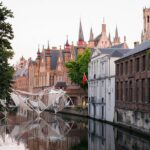
St. Boniface Bridge is next, and it plays a simple but important role in the route. After churches and indoor spaces, a canal bridge is the perfect place to reset—look outward, take photos, and let your eyes rest.
This stop works well with the audio because the narration isn’t just naming the bridge. It frames it as a connector between medieval neighborhoods, so you notice the way Bruges is shaped by waterways and street networks.
It’s also a nice timing buffer if you’ve fallen behind. Even if you’re not perfectly on pace, you can still get value from a short bridge break.
Stop 8: Burg Square for the civic heart of Bruges
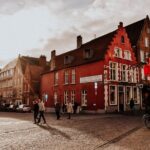
Then comes Burg Square, one of the city’s central stages. The route calls out the Basilica of the Holy Blood, City Hall, and the impressive Belfry area. The square is where Bruges feels “official,” and it’s where you can connect the dots between religious life and civic power.
The audio approach here is helpful because Burg Square can be overwhelming visually. Instead of trying to memorize everything at once, you get a guided set of priorities.
Practical consideration: if you’re photographing, do it quickly. Squares turn into crowd magnets, and the tour timing assumes you’ll keep moving.
Stop 9: Basilica of the Holy Blood for a sacred relic stop
Right in the heart of Burg Square, the route highlights the Basilica of the Holy Blood. The audio points you to the Gothic stairway and the venerated phial.
Even if you’re not a relic-focused visitor, this is an important Bruges stop because it explains how belief shaped architecture and how the city preserved a specific spiritual identity in a very public setting.
Practical consideration: Bruges church timing can be unpredictable, so keep your expectations flexible. If you can’t linger, aim for the featured relic moment and the key architectural cues mentioned in the audio.
Stop 10: Belfort for panoramic views and carillon sounds
Finally, the route ends at Belfort (the Belfry) in Markt Square. The highlights on this stop include the 366 steps for panoramic views and the carillon connection—plus the medieval clockwork idea.
This is a great closing moment because it ties everything together. From the top, the city makes more sense: streets, canals, and squares connect into a readable map. And the Belfry is a classic Bruges symbol of civic pride, so it feels like a proper finale.
Again, remember entrance fees/tickets aren’t included. If the climb is ticketed, you’ll need to handle that separately.
Who this smartphone audio tour is best for
This Bruges walking tour works especially well if you:
- want independence and a schedule you control
- like walking cities with clear route guidance
- travel solo and want easy navigation without a group rhythm
- prefer short informative segments over long lectures
It’s also a solid choice for first-timers because the stops cover key landmarks in a sensible order. You’ll get city-shaping features (towers, civic squares, major churches), plus calmer breaks (Minnewater) and quieter lived-in history (Ten Wijngaarde).
When it might not be your best match
If you want a lot of “tell me the story” conversation, this won’t replace a human guide. It’s an audio guide app, and the tour is self-guided—so you won’t have someone to answer your specific questions on the spot.
Also, if you’re the kind of traveler who spends a long time inside museums or reads every plaque, the 1-hour format might feel too tight. You’ll still get the main highlights, but you might want to follow up with extra time at one or two stops later.
One more note: one review mentioned the audio can break a couple of times. That doesn’t mean it will for you, but it’s a good reminder to keep your setup smooth and your expectations flexible.
Should you book this Bruges audio guide walk?
If you want a practical Bruges highlights walk without the pressure of a big group, I think this one is a strong pick. For the price, you’re getting an offline-friendly route, lots of audio guidance, and a sensible loop that hits Poertoren, Minnewater, Ten Wijngaarde, major churches, Burg Square, and Belfort.
I’d book it if you like touring at your own pace and you’re okay handling navigation and headphones yourself. I’d think twice if you need live answers, or if you know you’re likely to linger for hours in interiors—because this route is built for about an hour.
FAQ
Is this tour self-guided?
Yes. It’s a self-guided smartphone audio tour. You’ll download the audio guide app, activate your purchase, and follow the route using the mobile map with no human guide.
How long is the Bruges walking tour?
It’s listed as about 1 hour.
Where do I start, and where does it end?
You start at Gunpowder Tower (Poertoren) at Begijnenvest 1, 8000 Brugge, Belgium. The tour ends back at the same meeting point.
What do I need on my phone to use the audio guide?
You’ll use the audio guide app for iOS and Android, and you’ll need to activate your purchase and follow the offline map route.
Do I need to bring headphones?
Yes. Headphones are not included, so you should bring your own.
What language is the audio guide offered in?
The audio guide is offered in English.
Are entrance tickets included for the stops?
No. Entrance fees/tickets are not included.